SOLAR WIND SURROUNDS EARTH: For the fifth day in a row, Earth is surrounded by a fast-moving stream of solar wind flowing from a large hole in the sun's atmosphere. NOAA forecasters say there is a 40% chance of G1-class geomagnetic storms on Jan. 8th as bright auroras flicker around the Arctic Circle. Free: Aurora Alerts

ARCTIC COLORS: When people think of "Arctic colors," they usually visualize green, the heavenly hue of Northern Lights. But that's only one dab on the palette of polar chromatography. While auroras paint the night sky, twilight rays of exquisite beauty rule the day. On Jan. 5th, photographer Sarah Skinner captured the latter in this photo she took from Abisko National Park located 250 km inside the Arctic Circle:
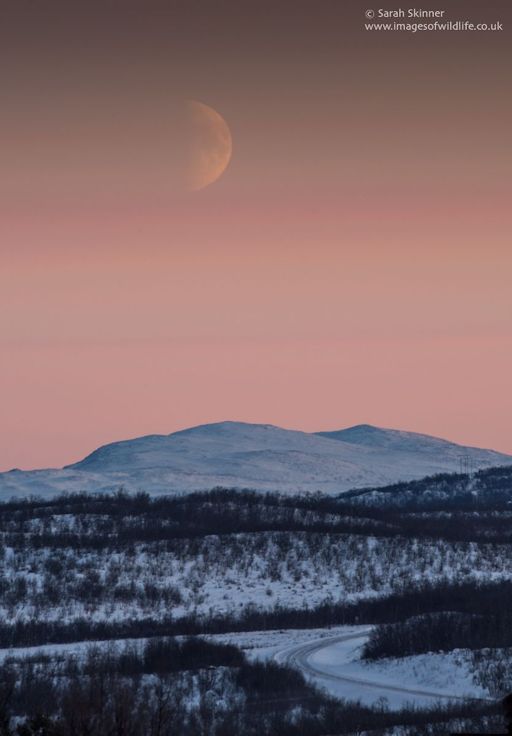
"It was approaching midday yesterday when I looked out of the window and noticed the most incredibly beautiful pink sky," says Skinner. "Linear clouds adorned the sky as the Moon was beginning to rise, looming over the frozen landscape."
In Abisko, the sun never rises at this time of year, but it does approach the horizon from below. Twilight colors spill over the landscape for hours at a time, creating scenes of enduring loveliness that cannot be found at lower latitudes.
"The striking pink hue stayed in the sky for quite some time, providing ample opportunity to capture some lovely images," adds Skinner. "Such colours and subtle lighting at this time of the year makes the Arctic region such a fabulous destination for photography." More of Sarah's images may be found on her web page, Andy and Sara Skinner Wildlife & Nature Photography.
LIGHT PILLARS OVER LATVIA: This morning in Riga, Latvia, photographer Ivo Dinsbergs stepped outside for a wakening breath of brisk winter air. The predawn sky was not peppered with stars, but instead subdivided by vertical columns of light:
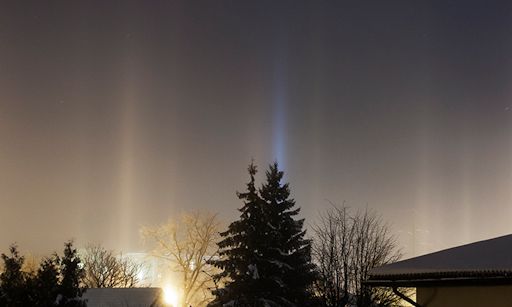
These are light pillars, caused by ice crystals in the air which intercept urban lights and spread them into colorful columns. The key ingredients of this phenomenon are ice and light pollution.
"Each pillar was rising directly above an unshielded street light," says Dinsbergs. Intrigued, he decided to collect some crystals from the air and photograph them:
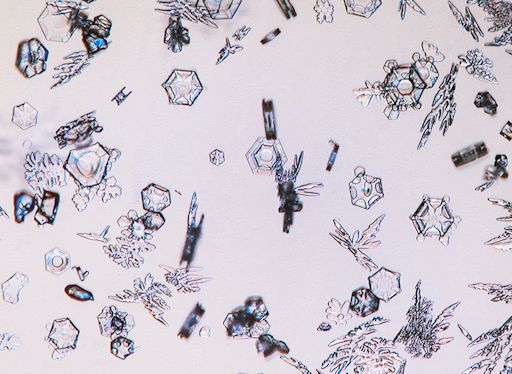
"Most of them were hexagonal plates," he notes.
That's to be expected. Flat six-sided ice crystals are perfectly shaped for making light pillars. The crystals flutter down from low-hanging clouds with their wide flat faces nearly parallel to the ground, much like a leaf falling from a tree. In this way they form an array of mirrors, reflecting street lights up and down, pillar-style.
Light pillars are a common sight in northern towns during winter. Look for more in the realtime photo gallery:
Realtime Space Weather Photo Gallery
Realtime Airglow Photo Gallery