THE SOLAR WIND ... IT'S STILL BLOWING: For the fifth day in a row, a fast-moving stream of solar wind is blowing around Earth. Inside the Arctic Circle, isolated geomagnetic storms are producing occasional bright auroras: photo gallery. Earth should begin to exit the stream on Jan. 10th. Free: Aurora Alerts
PILEUS CLOUDS: On Jan. 6th, Peter Lowenstein observed a rainbow-colored saucer over Mutare, Zimbabwe--but it wasn't a UFO. "This is a classic example of a pileus cloud," he says.
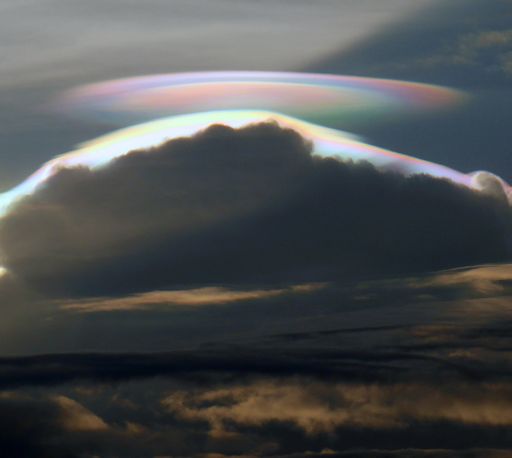
Pileus clouds form on sunny afternoons when the heat of the summer sun causes cumulus clouds to boil upwards. Roiling toward the sky, cumulus clouds push layers of moist air above them where they cool and condense to form droplet-rich cloud caps or 'pileus' (Latin for cap).
Sometimes, as in Mutare on Jan. 6th, pileus clouds form very quickly. In such cases their water droplets tend to be all the same size--the perfect condition for iridescent colors.
Lowenstein took four pictures over a period of just three minutes. "They show the cloud appearing, then changing shape and color," he says. "One minute later it had disappeared behind the summit of the growing cumulonimbus cloud."
Realtime Space Weather Photo Gallery
ARCTIC COLORS: When people think of "Arctic colors," they usually visualize green, the heavenly hue of Northern Lights. But that's only one dab on the palette of polar chromatography. While auroras paint the night sky, twilight rays of exquisite beauty rule the day. On Jan. 5th, photographer Sarah Skinner captured the latter in this photo she took from Abisko National Park located 250 km inside the Arctic Circle:
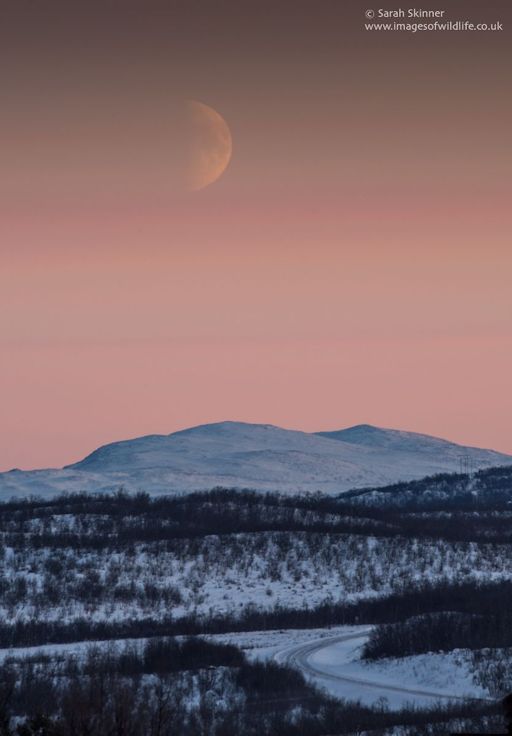
"It was approaching midday yesterday when I looked out of the window and noticed the most incredibly beautiful pink sky," says Skinner. "Linear clouds adorned the sky as the Moon was beginning to rise, looming over the frozen landscape."
In Abisko, the sun never rises at this time of year, but it does approach the horizon from below. Twilight colors spill over the landscape for hours at a time, creating scenes of enduring loveliness that cannot be found at lower latitudes.
"The striking pink hue stayed in the sky for quite some time, providing ample opportunity to capture some lovely images," adds Skinner. "Such colours and subtle lighting at this time of the year makes the Arctic region such a fabulous destination for photography." More of Sarah's images may be found on her web page, Andy and Sara Skinner Wildlife & Nature Photography.
Realtime Airglow Photo Gallery