CHANCE OF STORMS ON JAN. 12TH: NOAA forecasters estimate a 40% chance of polar geomagnetic storms on Jan. 12th. The cause is twofold: (1) Earth is expected to cross a fold in the heliospheric current sheet; and (2) a minor solar wind stream will hit Earth's magnetic field. Arctic sky watchers should be alert for auroras in response to this double whammy. Free: Aurora Alerts
SUNSPOTS VANISH, SPACE WEATHER CONTINUES: So far in 2017, the big story in space weather is sunspots--or rather, the lack thereof. So far this year, the sun has been blank more than 90% of the time. Only one very tiny spot observed for a few hours on Jan. 3rd has interrupted the string of spotless days. Devoid of dark cores, today's sun is typical of the year so far:
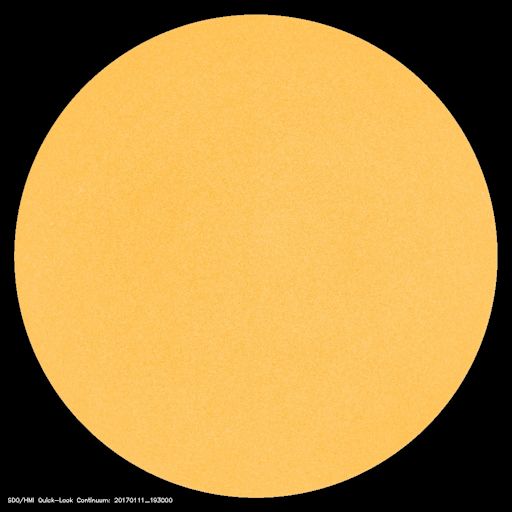
The last time the sun produced a similar string of spotless days was May of 2010, almost 7 years ago. That was near the end of the previous deep Solar Minimum. The current stretch is a sign that Solar Minimum is coming again. Sunspot numbers rise and fall with an ~11-year period, slowly oscillating between Solar Max and Solar Min. In 2017, the pendulum is swinging toward the bottom.
Contrary to popular belief, space weather does not stop when sunspots vanish. Recent nights are proof: Bright auroras have been dancing around the Arctic Circle. Tom Arne Moldenaes of Norway,Groetfjord, recorded this eruption--"like green lava from a volcano," he says--on Jan. 5th when the face of the sun was absolutely blank:
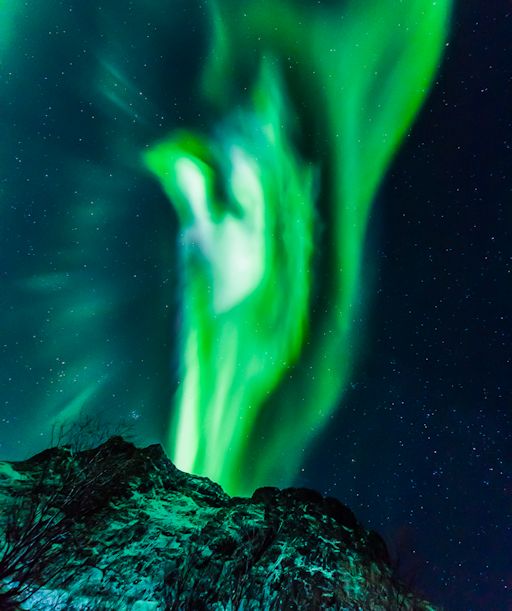
The auroras were sparked by a stream of solar wind flowing from a large hole in the sun's atmosphere. Such "coronal holes" are common during Solar Minimum.

A lot of interesting things happen when sunspots vanish. For instance, the extreme ultraviolet output of the sun plummets. This causes the upper atmosphere of Earth to cool and collapse. With less air "up there" to cause orbital decay, space junk accumulates around our planet.
Also during Solar Minimum, the heliosphere shrinks, bringing interstellar space closer to Earth. Galactic cosmic rays penetrate the inner solar system with relative ease. Indeed, a cosmic ray surge is already underway, with implications for astronauts and even ordinary air travelers.
Stay tuned for updates as we enter a new phase of the solar cycle.
PILEUS CLOUDS: On Jan. 6th, Peter Lowenstein observed a rainbow-colored saucer over Mutare, Zimbabwe--but it wasn't a UFO. "This is a classic example of a pileus cloud," he says.
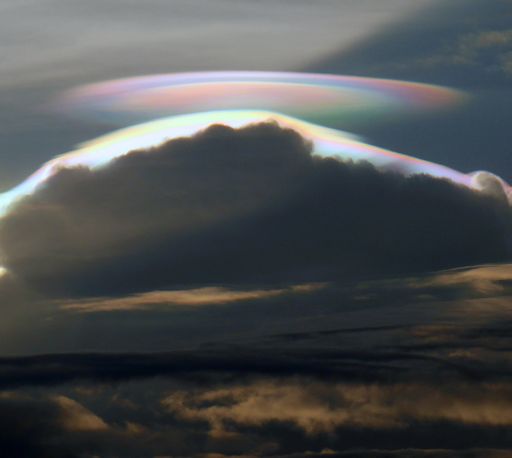
Pileus clouds form on sunny afternoons when the heat of the summer sun causes cumulus clouds to boil upwards. Roiling toward the sky, cumulus clouds push layers of moist air above them where they cool and condense to form droplet-rich cloud caps or 'pileus' (Latin for cap).
Sometimes, as in Mutare on Jan. 6th, pileus clouds form very quickly. In such cases their water droplets tend to be all the same size--the perfect condition for iridescent colors.
Lowenstein took four pictures over a period of just three minutes. "They show the cloud appearing, then changing shape and color," he says. "One minute later it had disappeared behind the summit of the growing cumulonimbus cloud."
Realtime Space Weather Photo Gallery
Realtime Airglow Photo Gallery