CHANCE OF STORMS, UPDATED: NOAA forecasters have lowered the odds of polar geomagnetic storms on Jan.13th to 25% as they wait for the late arrival of a solar wind stream. The stream was originally due to hit Earth's magnetic field on Jan. 12th. Even a day late, it could still light up the Arctic Circle. The stream is preceded by a CIR (co-rotating interaction region)--a transition zone between fast- and slow-moving solar wind. Plasma piles up in CIRs, producing density gradients and shocks that often do a good job sparking auroras. Free: Aurora Alerts
SURPRISE, IT'S A SUNSPOT: Breaking a string of 8 consecutive spotless days, a new sunspot (AR2625) has emerged over the sun's eastern limb. It announced itself on Jan.12th with a C4-class solar flare. The explosion hurled a plume of plasma into space, photographed by extreme ultraviolet cameras onboard NASA's Solar Dynamics Observatory:
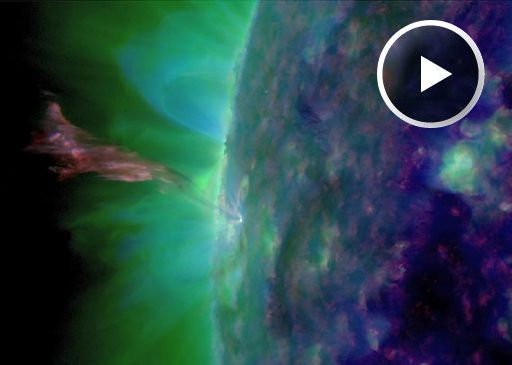
Earth will not feel any effects from this relatively minor flare. Material billowing away from the blast site is moving too far off the sun-Earth line to intersect our planet.
During years of Solar Maximum, a C-class flare issuing from a small sunspot like AR2526 would have been beneath the notice of busy space weather forecasters tracking more potent explosions. Now, however, sunspot numbers have dropped so low that even a small sunspot attracts attention. Sunspots and solar flares will recede in importance in the years ahead as Solar Minimum takes hold. Other forms of space weather will be making the news, instead. Stay tuned!
URSUS STRATOSPHERUS: Valentine's Day is coming. To prepare, you might need a space bear. Or two:
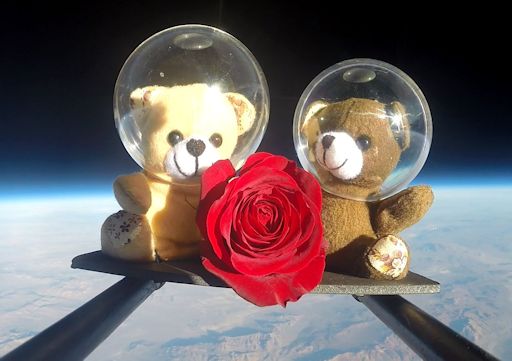
To fund their cosmic ray research, the students of Earth to Sky Calculus have flown 20 pairs of brown bears to the edge of space. You can have a pair for only $69.95--including the rose, which has been pressed for safekeeping. Each adorable duo comes with Valentine's card showing the bears in flight and certifying their trip to the stratosphere.
More out of this world gifts may be found in the Earth to Sky store. All proceeds support cosmic ray balloon launches and STEM education.
Realtime Space Weather Photo Gallery
SKI HALOS: Ski resorts are one of the best places to see sun halos--rings of light that surround the sun when ice crystals fill the air. On Jan. 9th, Stefanie Nopper was riding the cable car to Switzerland's Melchsee-Frutt ski resort when she witnessed this specimen:
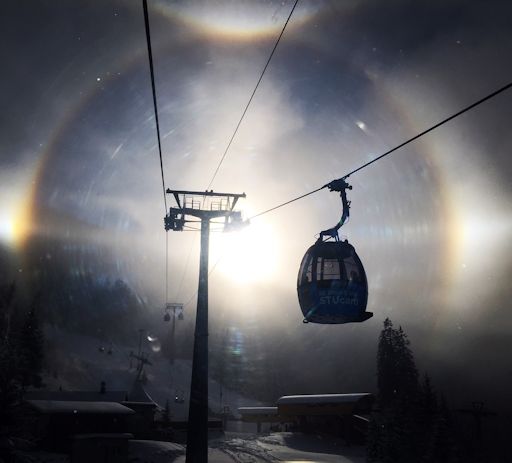
"First I saw a tiny rainbow and suddenly I realized, there is more than one... NO, it was an entire HALO!" she says. "I snapped this picture through the window using my iPhone."
Most sun halos are caused by ice crystals floating high above Earth's surface in cirrus clouds. "Ski halos," on the other hand, are formed by ice crystals near the ground, kicked into the air by the action of skis and snow-making machines.
Crystals emerging from snow-making machines can be particularly influential. A variety called "diamond dust" grows slowly downwind of ski-slope snow blowers. These man-made crystals tend to be more optically perfect than natural crystals in clouds, producing extra-bright, extra-sharp halos.
Going skiing? Be alert for halos. More examples may be found in the realtime photo gallery.
Realtime Space Weather Photo Gallery
Realtime Airglow Photo Gallery