THE END OF IRIDIUM FLARES: Backyard astronomers have long enjoyed the sight of "Iridium flares," supernova-like flashes in the sky caused by sunlight glinting from Iridium satellite antennas. Soon, these flares will come to an end. Earlier today, a SpaceX rocket launched the first batch of Iridium NEXT satellites, successors to the original Iridiums. They do not have the same antenna configuration and will not produce the same bright flares. Once the original constellation is de-orbited the flashes will cease. "I'm afraid those who've been tracking that phenomenon over the past 20 years have another year or two to see it," said Iridium CEO Matt Desch in an article from the BBC.
SOLAR WIND, INCOMING: A wide hole in the sun's atmosphere is spewing a fan-shaped stream of solar wind toward Earth. NASA's Solar Dynamics Observatory photographed the canyon-like structure on Jan. 14th:

This is a "coronal hole" (CH)--a region where the sun's magnetic field opens up and allows solar wind to escape. Material is flowing from this coronal hole at speeds exceeding 600 km/s (1.3 million mph). The high-speed stream could spark G1-class geomagnetic storms when it arrives on Jan. 18-19. Arctic sky watchers, mark your calendars! Free: Aurora Alerts
ATMOSPHERIC RADIATION MONITORING: As the solar cycle transitions to a new phase, cosmic rays are penetrating the solar system in ever increasing numbers. Cosmic rays can seed clouds, trigger lightning, and penetrate commercial airplanes. This means it is increasingly important to monitor radiation in Earth's atmosphere. Spaceweather.com and the students of Earth to Sky Calculus have developed a "Space Weather Buoy" to do just that. A peer-reviewed research article describing the device was just featured on the cover of the American Geophysical Union magazine Space Weather Quarterly:

Download the entire issue and scroll down to page 10 to read the complete article. It was co-authored by 12 students, most of whom were in high school when the research was done. Highlights of the article include a detailed description of the buoy as well as measurements of several radiation events over California in response to solar activity.
Our radiation monitoring program receives no support from corporate sponsors or government grants. Instead, we are crowd-funded. Or rather ... bear-funded:
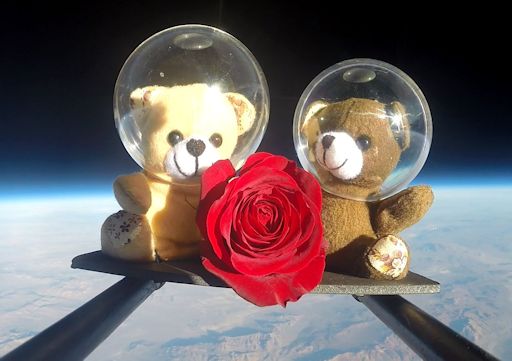
Sales of Valentine's gifts like these space bears support our research. All proceeds support cosmic ray balloon launches and STEM education.
Get a pair for yourself. They're only $69.95--including the rose, which has been pressed for safekeeping. Each adorable duo comes with Valentine's card showing the bears in flight and certifying their trip to the stratosphere. More out of this world gifts may be found in the Earth to Sky store.
Realtime Space Weather Photo Gallery
Realtime Airglow Photo Gallery