SUNSPOT GENESIS: Barely visible only 24 hours ago, a new sunspot group big enough to swallow Earth is bubbling up through the solar surface. Watch the rapid genesis of this new active region in a movie from NASA's Solar Dynamics Observatory:

In recent months sunspot numbers have plummeted as the solar cycle crashes toward a new and deep Solar Minimum expected in 2019-2020. So what is this sunspot doing here? It's a reminder that the sun can produce spots at all phases of the solar cycle. Individual sunspots are completely unpredictable and may appear without notice at any time. Even during the great Maunder Minimum of the 17th century, a handful of sunspots were typically observed each year. This is important because sunspots produce solar flares. As a result, occasionally Solar Minimum explodes with solar flare activity.
So far, baby sunspot AR2629 poses no threat for strong solar flares; its magnetic field is too stable for such explosions. However, this could change if its development proceeds apace. Stay tuned for updates.
Realtime Space Weather Photo Gallery
CORONAL HOLE FACES EARTH: A hole in the sun's atmosphere is directly facing Earth, and it is spewing a stream of solar wind in our direction. NASA's Solar Dynamics Observatory photographed the structure during the early hours of Jan. 24th:

This is a "coronal hole" (CH)--a region in the sun's atmosphere where the magnetic field opens up and allows solar wind to escape to escape. The emerging stream of gas should reach Earth on Jan. 27th or 28th and influence our planet for 2 to 3 days. Arctic sky watchers, mark your calendars. Auroras are in the offing later this week. Free: Aurora alerts.
FAR-OUT VALENTINE'S GIFT: To raise money for their cosmic ray ballooning program, the students of Earth to Sky Calculus have flown a payload-full of Valentine's pendants to the edge of space--and you can have one for $89.95. Buy one this week and we will include a space rose free of charge.
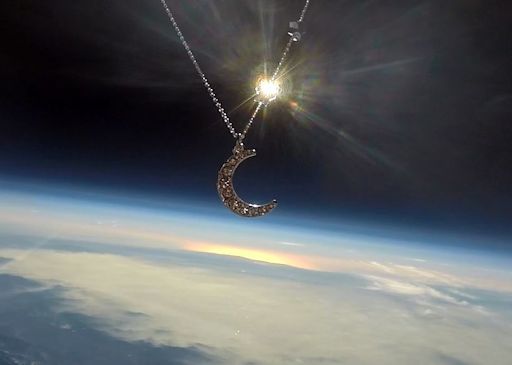
Each glittering pendant comes with a greeting card showing the jewelry in flight and certifying that it has been to the stratosphere and back again.
More far-out Valentine's gifts may be found in the Earth to Sky store. All proceeds support cosmic ray balloon flights and STEM education.
Realtime Airglow Photo Gallery