THE SOLAR WIND HAS ARRIVED: Arriving a day earlier than expected, a stream of solar wind hit Earth's magnetic field on Jan. 27th. This is causing intermittent G1-class geomagnetic storms and Northern Lights around the Arctic Circle. Jónína Óskarsdóttir sends this photo from Faskrudsfjordur, Iceland:


"I wasnt expecting much when I went out," says Óskarsdóttir, "but I had a wonderful time with great northern lights activity."
The solar wind responsible for this display is flowing from a hole in the sun's atmosphere. It is expected to influence our planet for the next 2 to 3 days, with a 40% chance of continued geomagnetic storms on Jan. 27th and Jan. 28th. Arctic sky watchers should remain alert for auroras this weekend. Free: Aurora Alerts
ALTERNATE AURORAS: On Jan. 24th, photographer Dave Bell of Pinedale, Wyoming, witnessed a display of colorful lights in the sky. They looked liked auroras--but they were not.
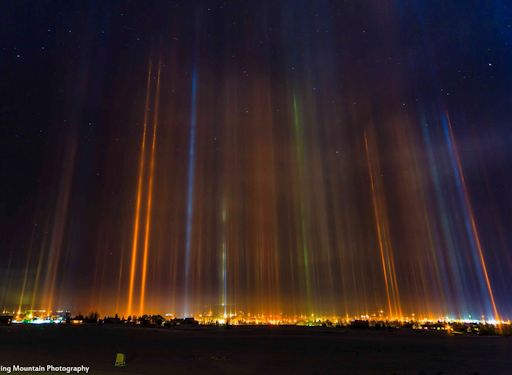
They're light pillars, caused by ice crystals in the air which intercept urban lights and spread them into colorful columns. Sometimes called "false auroras," no solar activity is required for the phenomenon. The only ingredients are ice and light pollution.
"We had a really terrific snowstorm in Pinedale for 36 hours," says Bell. "As the storm cleared and temperatures plummeted, fine crystals of ice filled the air and we were treated to a spectacular display of pillars. A friend recently commented that light pillars are like our version of the aurora borealis."
Realtime Space Weather Photo Gallery
FAR-OUT VALENTINE'S GIFT: To raise money for their cosmic ray ballooning program, the students of Earth to Sky Calculus have flown a payload-full of Valentine's pendants to the edge of space--and you can have one for $89.95. Buy one this week and we will include a space rose free of charge.
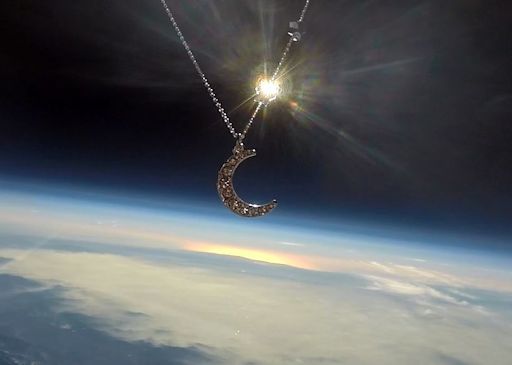
Each glittering pendant comes with a greeting card showing the jewelry in flight and certifying that it has been to the stratosphere and back again.
More far-out Valentine's gifts may be found in the Earth to Sky store. All proceeds support cosmic ray balloon flights and STEM education.
TWO BIG HOLES IN THE SUN'S ATMOSPHERE: NASA's Solar Dynamics Observatory is now tracking two large holes in the sun's atmosphere. One (on the right) is almost directly facing Earth, and the other (left) is still turning toward us:

These are "coronal holes" (CHs)--places in the sun's atmosphere where the sun's magnetic field opens up and allows solar wind to escape. Coronal holes turn the sun into a kind of gassy lighthouse. They strobe Earth with streams of solar wind every 27 days, the rotation period of the sun.
Earth will encounter solar wind streams from both of these holes. The first is due to arrive on Jan. 27th. (Update: it's here!) The second, larger stream should reach our planet on or about Feb 1st. Arctic sky watchers, mark your calendars; auroras are in the offing.
Realtime Airglow Photo Gallery