WEEKEND AURORA WATCH: This weekend, a solar wind stream is gently buffeting Earth's magnetic field. As a result, NOAA forecasters estimate a 40% chance of polar geomagnetic storms on Jan. 28th. Arctic sky watchers should be alert for auroras. [realtime photo gallery]
SUPERCOOLED RAINBOW: When the temperature dips below freezing, rainbows vanish, right? Rainbows require liquid raindrops, and frozen water doesn't do the trick. Yesterday in Alaska, however, a rainbow appeared that seemed to defy the simple laws of physics. John Dean photographed the pale arc over Nome:
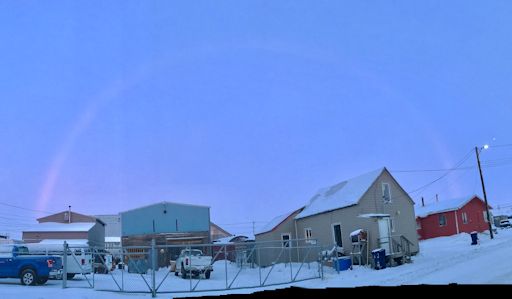
"It was not raining," says Dean. "The temperature was 25 F and a light snow storm had just passed through about an hour before. This is a first for me, and it has me perplexed."
Atmospheric optics expert Les Cowley explains what happened: "This is definitely a rainbow made by water drops, even though it was so cold. Ice spheres, hail or snowflakes cannot make them because a rainbow needs almost perfectly spherical, smooth and transparent water drops. This bow is broad, telling us that the water drops were small. They were also probably quite high up, and might even have been supercooled below the normal freezing point of water."
Supercooled raindrops can form when droplets of water fall through layers of subfreezing air. Droplets containing specks of dust or even microbes readily freeze as ice crystals form around the impurities. But when rain droplets are especially pure, they can remain in a liquid state even when the temperature drops below freezing.
Hence -- the "supercooled rainbow." High latitude sky watchers should be alert for these rare rainbows as strange Arctic weather grips the North in winter 2017.
Realtime Space Weather Photo Gallery
POLAR STRATOSPHERIC CLOUDS: Earth's stratosphere is normally free of clouds. Not this weekend, though. Observers in northern parts of Scandinavia are reporting an outbreak of brilliantly-colored icy clouds in the typically dry and transparent layer of our planet's atmosphere. Mia Stålnacke sends this picture from Kiruna, Sweden:
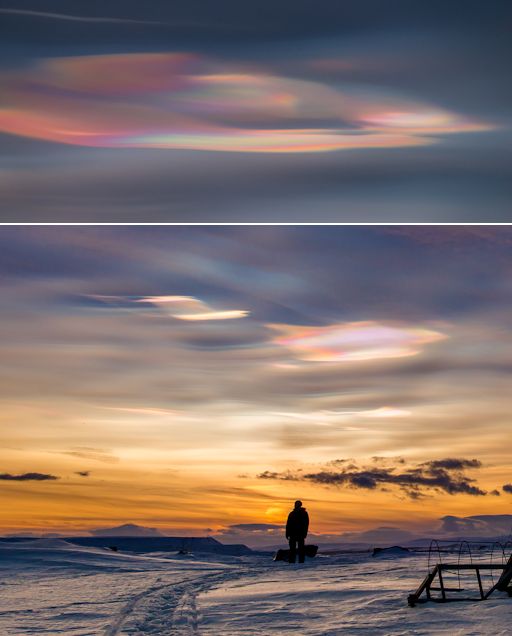
"Stratospheric clouds have been appearing almost daily lately up here in the subarctic," says Stålnacke. "We had a beautiful display today (Jan 28th) just after sunset!"
These icy clouds are a sign of very cold temperatures. For ice crystals to form in the arid stratosphere, temperatures must drop to around -85º C. High-altitude sunlight shining through tiny ice particles ~10µm across produce the characteristic bright iridescent colors.
Once thought to be mere curiosities, some polar stratospheric clouds (PSCs) are now known to be associated with the destruction of ozone. Indeed, an ozone hole formed over the UK in Feb. 2016 following an outbreak of ozone-destroying Type 1 PSCs.
Realtime Space Weather Photo Gallery
FAR-OUT VALENTINE'S GIFT: Nothing says "I love you" like a bear from space. To raise money for their cosmic ray research program, the students of Earth to Sky Calculus have flown a payload-full of Valentine's bears to the edge of space. This was a special flight, timed to photograph the bears at sunset in the stratosphere, wrapped in the romantic light of the fading sun 98,000 feet above Earth's surface:
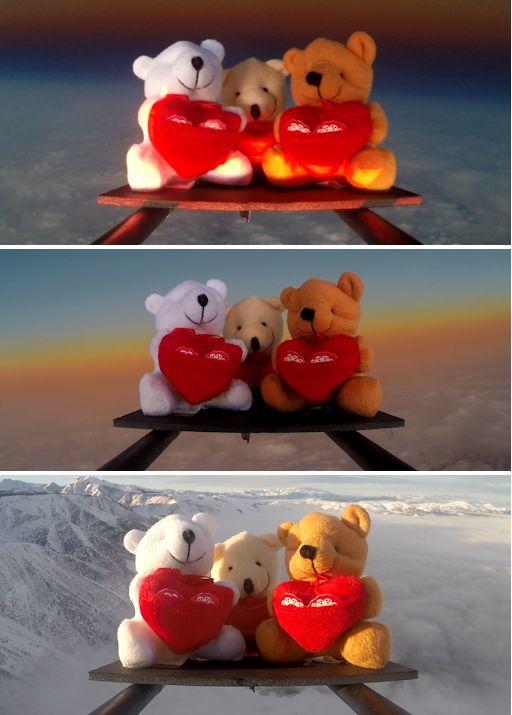
You can have one for $49.95. Each bear comes with a Valentine's card showing the bears in flight and telling the story of their trip to the stratosphere.
More far-out Valentine's gifts may be found in the Earth to Sky store. All proceeds support cosmic ray balloon flights and STEM education.
Realtime Airglow Photo Gallery