SUNSET SKY SHOW: When the sun goes down tonight, step outside and look southwest. The crescent Moon is joining bright Venus and red Mars to form a triangle in the sunset sky. Try to catch them before the sky fades to black. A conjunction of bright planets framed by twilight blue is extra beautiful. Sky maps: Jan. 30, 31.


A HOLE IN THE SUN'S ATMOSPHERE: A large, canyon-shaped hole has opened in the sun's atmosphere, and it is spewing a stream of solar wind directly toward Earth. NASA's Solar Dynamics Observatory photographed the structure, which stretches more than halfway across the face of the sun:
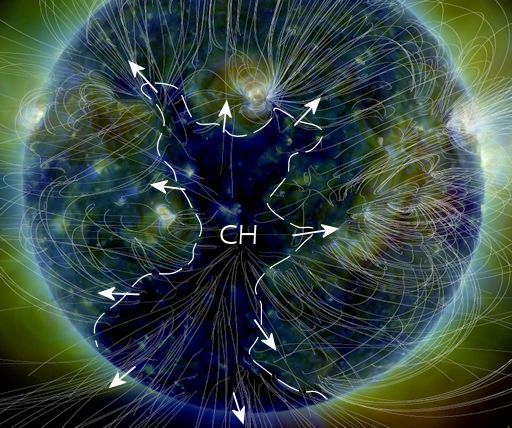
This is a "coronal hole" (CH)--a region where the sun's magnetic field opens up and allows solar wind to escape. NASA's STEREO spacecraft recently sampled the stream flowing from this hole and the velocity was unusually high: nearly 750 km/s. Such a fast-moving stream will likely spark Arctic auroras when it arrives on Feb. 1st. Stay tuned! Free: Aurora alerts.
A VISIT FROM THE ANCESTORS: "Things are getting spooky around the Arctic Circle," reports Markus Varik. Last night, he photographed this apparition over Tromsø, Norway:

"According to the local indigenous Sami people, Northern Lights represent the souls of ancestors. When teased, the spirits descend and pick up the teaser--never to be seen again," says Varik. "Working as a seasoned Northern Lights guide, I have done my fair share of teasing. This time, luckily, I was released after a short inspection."
In addition to teasing, another factor may have played a role in conjuring these auroras: Earth passed through a fold in the heliospheric current sheet. Many people have never heard of the heliospheric current sheet, yet it is one of the biggest things in the solar system--a vast undulating system of electrical currents shaped like the skirt of a ballerina. Earth dips in and out of it all the time. These crossings are called "solar sector boundary crossings," and they have been known to spark bright Arctic lights.
Realtime Space Weather Photo Gallery
FAR-OUT VALENTINE'S GIFT: Nothing says "I love you" like a bear from space. To raise money for their cosmic ray research program, the students of Earth to Sky Calculus have flown a payload-full of Valentine's bears to the edge of space. This was a special flight, timed to photograph the bears at sunset in the stratosphere, wrapped in the romantic light of the fading sun 98,000 feet above Earth's surface:
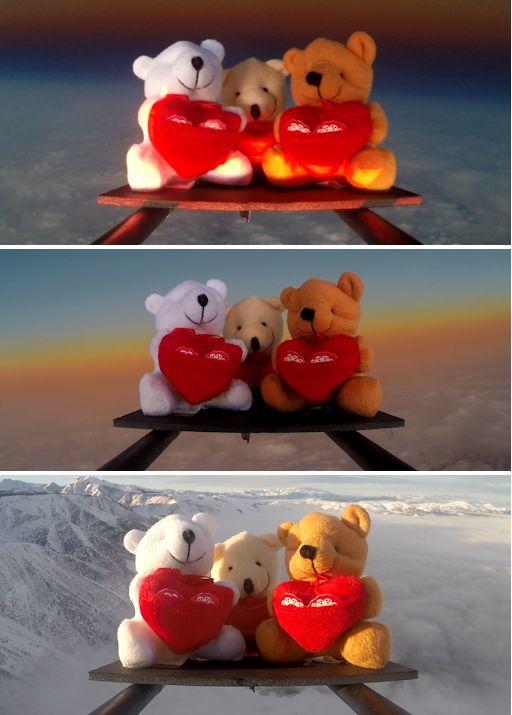
You can have one for $49.95. Each bear comes with a Valentine's card showing the bears in flight and telling the story of their trip to the stratosphere.
More far-out Valentine's gifts may be found in the Earth to Sky store. All proceeds support cosmic ray balloon flights and STEM education.
Realtime Airglow Photo Gallery