WAITING FOR THE SOLAR WIND: A narrow stream of solar wind that was supposed to hit Earth's magnetic field yesterday, did not. The tardy stream is still en route and may arrive later today, bringing with it a 25% chance of polar geomagnetic storms. Arctic sky watchers should be alert for auroras after nightfall. Free: Aurora alerts.
DID COMET 45P LOSE ITS TAIL? At the end of December 2016, Comet 45P/Honda-Mrkos-Pajdusakova plunged toward the sun with a long tail streaming behind it. Now the comet is headiing for Earth for a close encounter on Feb. 11th. Apparently, however, it left something behind. "Comet 45P has lost its tail," reports Bill Williams of the Chiefland Astronomy Village in Florida, who photographed the approaching comet last night:
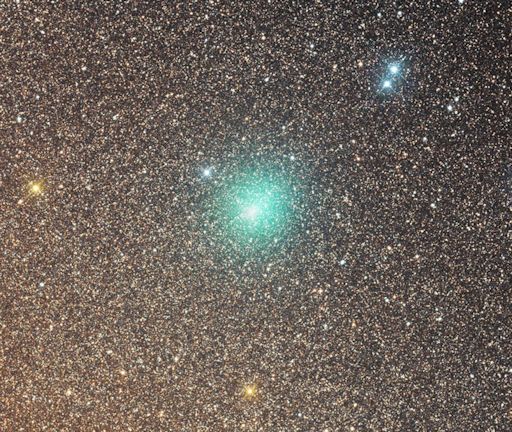
"The comet still sports a gorgeous green atmosphere ('coma') and is now exiting the dense Ophiuchus Milky Way starfield," says Williams. "The comet sure is moving fast!"
WIlliams isn't the only observer to notice the missing tail. Moreover, the comet is at least 3 times dimmer than forecasters expected. "It is rather faint and diffuse," notes Dr. Brian Ottum of Dark Sky New Mexico, who photographed the green fuzzball on Feb. 7th. "45P seems unlikely to reach naked eye visibility."
What happened? On Dec. 31, 2016, the comet slingshot around the sun inside the orbit of Venus. Solar heating might have vaporized so much material from the comet's icy core that there is insufficient left for a flamboyant tail. For the same reason, the comet may be dimmer than expected. Amateur astronomers with small telescopes can monitor the situation. The best time to look is during the dark hours before sunrise between Feb 9th and 12th. The comet will be racing through the constellation Hercules high in the eastern sky. Sky maps: Feb. 9, 10, 11, 12.


Got a great picture? First, submit it to Spaceweather.com. Next, send it to the Planetary Science Institute, which is collecting amateur images to help professional researchers study Comet 45P. More resources: 3D Orbit, Ephemeris.
SPACE JEWELRY FOR VALENTINE'S DAY: Did you know that cosmic radiation in Earth's atmosphere is increasing? It's true. These and other findings of the Earth to Sky Calculus ballooning program are funded not by government grants or corporate donations. Instead, the students rely on crowdfunding. Or rather, bling-funding:
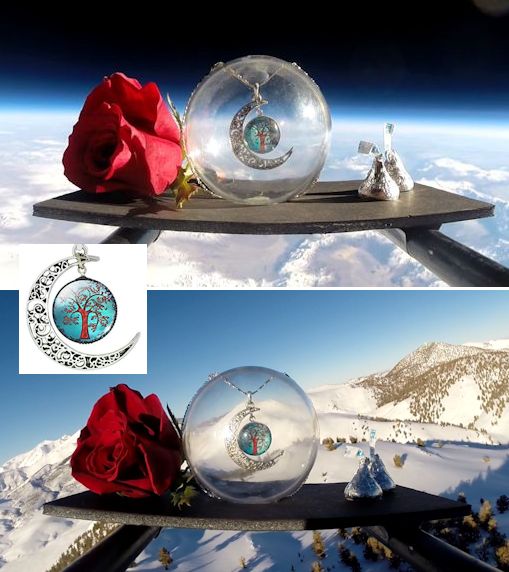
To raise funds for their ongoing research, on Jan.27th the students flew a payload-full of these Tree of Life Pendants to the edge of space. You can have one for $79.95. A space rose is included, too, pressed for safekeeping. Each pendant+rose gift package comes with a Valentine's card showing the bears in flight and telling the story of their trip to the stratosphere. Select 2nd Day Air at checkout to get it in time for Valentine's Day.
More out of this world gifts may be found in the Earth to Sky store.
LUNAR ECLIPSE THIS FRIDAY NIGHT: The full Moon will lose some of its usual luster on Friday night as an eerie shadow creeps across the lunar disk. It's a penumbral lunar eclipse, visible from every continent except Australia. Graphic artist Larry Koehn created this animation of the event:
A penumbral eclipse happens when the Moon passes through the pale outskirts of Earth's shadow. It is much less dramatic than a total lunar eclipse. In fact, when observers are not alerted beforehand, they often do not realize an eclipse is underway. Nevertheless, the subtle shadow of Earth is visible to the naked eye.
The best time to look is Friday night around 07:44 p.m. Eastern Time (00:44 UT). That's the time of maximum coverage when Earth's shadow creates a clear gradient of light and shadow across the lunar disk. Check out this global visibility map to see if you are in the eclipse zone:

According to folklore, a full Moon in February is called the "Snow Moon." For northerners, it often feels like the brightest Moon of the year as moonlight glistens off the white landscape. For a while on Friday night, it won't seem quite so bright.
Realtime Space Weather Photo Gallery
Realtime Airglow Photo Gallery