CO-ROTATING INTERACTION REGION: NOAA forecasters say there is a 45% chance of polar geomagnetic storms on Feb. 15th when a co-rotating interaction region (CIR) is expected to hit Earth's magnetic field. CIRs are transition zones between slow- and fast-moving solar wind streams. The often contain strong magnetic fields and density gradients that do a good job sparking auroras. A solar wind stream following the CIR could keep the Arctic Circle glowing for the rest of the week. Free: Aurora alerts.
POLAR STRATOSPHERIC CLOUDS AT NIGHT: Arctic nights are usually colored by the aurora borealis. Last night was different. The colors came from polar stratospheric clouds (PSCs). Lars Lehnert photographed the display from Abisko, Sweden:
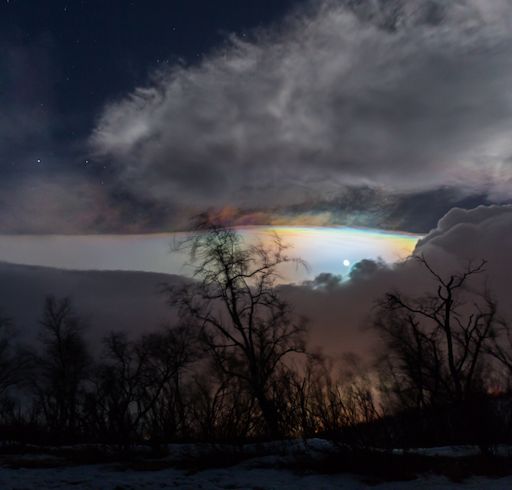
"We saw these clouds all day long," says Lenart, "and they continued into the night. I've never seen anything quite like it."
In Kiruna, Sweden, longtime PSC photographer Mia Stålnacke saw them, too: "This was a first for me!" she says. "The polar stratospheric clouds which lit up the Arctic skies in daylight are still here. Now they are beautifully lit up by the Moon instead!"
This is a remarkable episode of PSCs--the best in many years according to some longtime residents of northern Sweden. Arctic sky watchers should remain alert for more, both day and night, as this unusual winter continues.
BEST EVER? POLAR STRATOSPHERIC CLOUDS: Around the Arctic Circle, observers are reporting an outbreak of polar stratospheric clouds (PSCs). "Yesterday, Feb. 13th, the sky was filled with their brilliant colors from sunrise to sunset," says Mia Stålnacke, who sends this picture from Kiruna, Sweden:

These clouds are newsworthy because normally the stratosphere has no clouds at all. Home to the ozone layer, the stratosphere is arid and almost always transparent. Yet, Stålnacke says, "we've been seeing stratospheric clouds very often this winter and last."
According to multiple longtime residents of the area, the Feb 13th display was exceptional. "Everyone I spoke to agrees it was the best they had ever seen," says Chad Blakley, who operates the Lights over Lapland tour guide service in Abisko, Sweden.
"I've been living here all my life (33 years)," says Stålnacke. "I definitely feel that these clouds are appearing more often then they used to. I remember seeing them a few times/year since I was a kid, but these last couple of years we've had them much more often--sometimes for almost a week straight. Others seem to feel the same way; I see local groups on Facebook flooded with photos of PSCs and comments on how often they're appearing now."
"The clouds were all over Finland, too," says Matti Helin who took this picture on Feb. 13th:

What's going on up there?
PSCs are a sign of very cold temperatures in the stratosphere. The clouds are made of ice. Indeed, that is the source of their remarkable color: High-altitude sunlight shining through tiny ice particles ~10µm across produce a bright iridescent glow. For ice crystals to form in the very dry stratosphere, temperatures must drop to around -85º C.
Once thought to be mere curiosities, some PSCs are now known to be associated with the destruction of ozone. Indeed, an ozone hole formed over the UK in Feb. 2016 following an outbreak of ozone-destroying Type 1 PSCs.
To investigate these clouds further, Spaceweather.com and the students of Earth to Sky Calculus will travel to Abisko Sweden for a week in March 2017. We plan to launch a series of space weather balloons into the Arctic stratosphere, measuring temperature, air pressure, and ambient radiation. If PSCs are present, our sensors will pass directly through them, and our cameras can photograph the colorful clouds at point blank range. Stay tuned!
ROUND OBJECT CROSSES THE MOON: As observers around the planet were capturing images of Friday's penumbral eclipse, one photographer saw something unusual: a round object crossing in front of the Moon. "I was using a 125mm telescope to capture the eclipse when the small black disk appeared," says Luis G. Verdiales from Loiza, Puerto Rico. "It was moving too slow to be a satellite, so slow that I was able to capture it with my camera four times. It got my attention because it was round!"


Verdiales contacted the Caribbean Island's largest astronomy organization to find out what it was. Eddie Irizarry of the Sociedad de Astronomía del Caribe explains what happened next:
"After analysing magnified images, we suspected it might be a stratosphere balloon from Google Loon, a project that is testing internet coverage from the stratosphere," says Irizarry. "We checked FlightRadar24.com and indeed found a balloon at 64,400 ft identified as HBAL176. Further analysis showed the balloon was right between the observer and the Moon."
Realtime Lunar Eclipse Photo Gallery
Realtime Space Weather Photo Gallery