SOLAR WIND, INCOMING: A stream of solar wind is heading for Earth, due to arrive later today (Feb. 15th) or tomorrow (Feb. 16th). The stream is flowing from a canyon-shaped hole in the sun's atmosphere. NOAA forecasters say there is a 40% chance of polar geomagnetic storms when the solar wind arrives. Free: Aurora alerts.

DAYTIME AURORAS? NO. POLAR STRATOSPHERIC CLOUDS: On Feb. 13th, something amazing happened in the stratosphere over the Arctic Circle. Normally, the air 60,000+ feet above Earth's surface is dry and utterly transparent. On the eve of Valentine's Day, however, the Arctic stratosphere filled with a gossamer haze of crystalline ice, and when sunlight hit the freezing crystals, the sky filled with clouds of intense iridescent color.
"Our guests referred to the clouds as 'daytime auroras,'" reports Chad Blakley, who operates the Lights over Lapland tour guide service in Abisko, Sweden. One of them, Champ Cameron (@champcameron on Instagram), snapped this picture of the display:

Good thing. They witnessed an exceptional display of polar stratospheric clouds (PSCs). PSCs are a sign of very cold temperatures in the stratosphere. For ice crystals to form in the normally arid stratosphere, temperatures must drop to around -85º C. So while it was strangely warm on the ground below, it was incredibly cold up above.
Longtime observers say PSCs are becoming more common and more intense. "I've been living here all my life (33 years)," says Mia Stålnacke of Kiruna, Sweden, who also photographed the colorful outbreak. "I definitely feel that these clouds are appearing more often then they used to. I remember seeing them a few times/year since I was a kid, but these last couple of years we've had them much more often--sometimes for almost a week straight. Others seem to feel the same way; I see local groups on Facebook flooded with photos of PSCs and comments on how often they're appearing now."
"Our bus driver, a longtime resident of the area, described it as the best PSC display he had ever seen," relays Blakley. "We were overwhelmed by the natural beauty." The clouds were so intense, they remained visible even after the sun set:
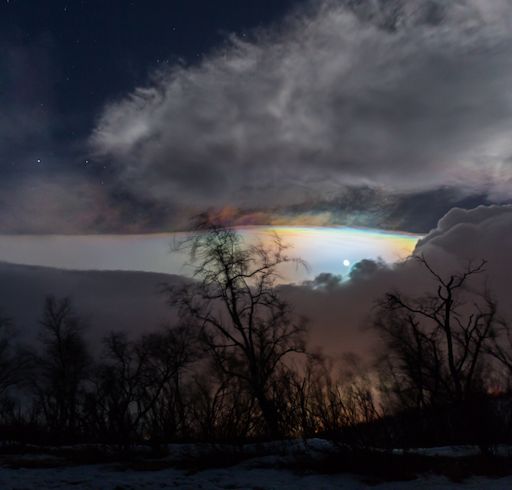
"We saw these clouds all day long, and they continued into the night," says photographer Lars Lehnert of Abisko, Sweden. " I've never seen anything quite like it."
Once thought to be mere curiosities, some PSCs are now known to be associated with the destruction of ozone. Indeed, an ozone hole formed over the UK in Feb. 2016 following an outbreak of ozone-destroying Type 1 PSCs.
To investigate these clouds further, Spaceweather.com and the students of Earth to Sky Calculus will travel to Abisko Sweden for a week in March 2017. We plan to launch a series of space weather balloons into the Arctic stratosphere, measuring temperature, air pressure, and ambient radiation. If PSCs are present, our sensors will pass directly through them, and our cameras can photograph the colorful clouds at point blank range. Stay tuned!
HAPPY BIRTHDAY, GALILEO: On February 15, 1564, Galileo Galilei was born in Pisa, Italy. Galileo is an important person in the history of space weather. Contrary to popular belief, he didn't discover sunspots, but he was one of the first to observe them using a telescope.
In Galileo's day, many people believed sunspots were satellites of the sun. Galileo proved otherwise. By drawing sunspots every day, he discovered that the sun spins and that sunspots are located on (or very near) the sun's surface. Galileo thought sunspots might be clouds.

Sunspots sketched by Galileo on June 25, 1613: more.
Now we know what sunspots really are: huge islands of magnetism. Magnetic fields generated by the sun's inner dynamo poke through the sun's surface, forming dark areas typically a few times wider than Earth. The behemoths Galileo sketched in 1613 were as wide as Jupiter.
If Galileo were alive today, the 453-year-old scientist would make less progress on the problem of sunspots. The solar cycle is currently crashing towards a deep minimum expected in 2019-2020; the sun's dark cores are shrinking and becoming less frequent. To the sunspots, we wish many happy returns.
Realtime Space Weather Photo Gallery