MAGNETIC UNREST: Earth's polar magnetic field is unsettled as our planet moves deeper into a stream of solar wind that arrived on Feb. 16th. Last night in Alaska, first contact with the stream turned skies green over Fairbanks, Alaska:

"My eyes were glued to the sky waiting for news about the Poker Flats Research Range, where some rockets were scheduled to be launched," says photographer Sacha Layos."The mission was eventually scrubbed because of weather issues, but the aurora put on a nice little show starting at at 8p.m.!"
The solar wind stream responsible for the display is flowing from a long canyon-shaped hole in the sun's atmosphere. It could affect our planet's space environment throughout the weekend. NOAA forecasters estimate a 45% chance of polar geomagnetic storms on Feb. 17th. Free: Aurora alerts.

NEUTRONS IN THE STRATOSPHERE: An unusually wide and sinuous hole has opened in the sun's atmosphere, and it is stretching like a gash across the sun's entire southern hemisphere. NASA's Solar Dynamics Observatory photographed the structure using false-color ultraviolet telescopes on Feb. 17th:

This is a "coronal hole" (CH)--a region where magnetic fields open up and allow solar wind to escape. Solar wind flowing from this coronal hole could buffet Earth's magnetic field, off and on, for the next two weeks. Much of the material will pass to the south of Earth, mitigating its impact. However, even the glancing effects of a two-week solar wind event could support a sustained display of polar auroras. Arctic sky watchers, February could end well for you.
NEUTRONS IN THE STRATOSPHERE: In a joint operation on Feb.12th, the students of Earth to Sky Calculus and their sister club Earth to Sky Maritime launched a neutron counter to the stratosphere onboard a high altitude balloon. Neutrons are an important form of cosmic radiation because they provide much of the biologically effective radiation dose at altitudes of interest to aviation and space tourism. How are these particles distributed through our atmosphere? This is what we wanted to find out.
We've just finished reducing the data and can report that the experiment was a success. Neutrons were detected throughout the 2 hour flight covering altitudes from ground level to 113,200 ft:
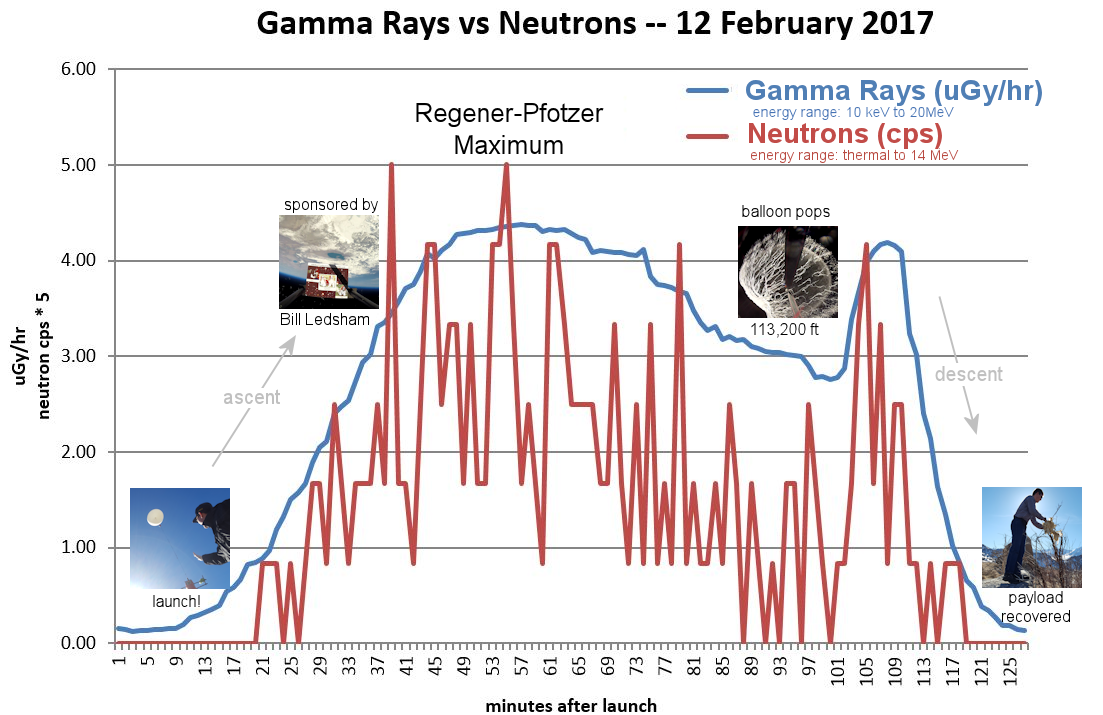
This first data set shows that neutrons, like gamma rays, peak at the entrance to the stratosphere in a layer known as the Regener-Pfotzer Maximum. Moreover, neutron counts are significantly elevated not only in the stratosphere, but also at lower altitudes where planes fly (20,000 ft to 45,000 ft)--something to think about the next time you buy an airline ticket.
We've been monitoring cosmic rays in the atmosphere for more than two years, and find that deep space radiation has been intensifying. Previous payloads measured only X-rays and gamma-rays, however. The addition of a neutron counter to the payload is a major upgrade, providing a more complete picture of the radiation environment. Stay tuned for updates as we improve our technique and gather more data in future flights.