ANNULAR SOLAR ECLIPSE: It's not a total eclipse, but it's the next best thing. On Sunday, Feb. 26th, the Moon will pass in front of the southern hemisphere sun, covering as much as 99% of the solar disk. Astronomers call this an "annular" solar eclipse. Observers in parts of South America and Africa will be able to witness a magnificent "ring of fire" in the sky as crescent-shaped sunbeams dance on the ground below. Watch this cool animation from ShadowandSubstance.com.
FLYING NORTH? GRAB THE WINDOW SEAT: Notice to air travelers: If you're going to be flying north this month, ask for a window seat. "Last night, flying from Denver to Calgary, I witnessed my first aurora from the window of an airplane over central Alberta," reports Mike Charnick, who took this picture using a hand-held digital camera:
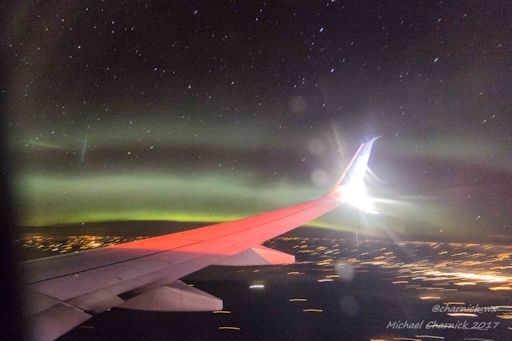
"I just pressed the lens to the glass and held it as steadily as I could for a 10 s exposure," says Charnick. "It may not be the clearest picture, but it was a true gift to see the aurora from 35,000 up in the sky!"
Northern Lights could be a common sight from airplane windows as February comes to an end. Earth is inside a solar wind stream that could influence our planet for the rest of the month. To understand why, read about the gash in the sun's atmosphere, below.
A GASH IN THE SUN'S ATMOSPHERE: An unusually wide and sinuous hole has opened in the sun's atmosphere, and it is stretching like a gash across the sun's entire southern hemisphere. NASA's Solar Dynamics Observatory photographed the structure using false-color ultraviolet telescopes on Feb. 17th:
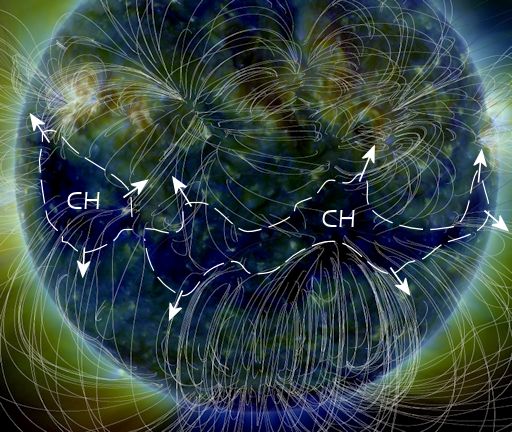
This is a "coronal hole" (CH)--a region where magnetic fields open up and allow solar wind to escape. A fan-shaped stream of solar wind flowing from this broad hole will buffet Earth's magnetic field, off and on, for the next two weeks.
Much of the material will pass to the south of our planet, mitigating its impact; this is not considered a major space weather event. Nevertheless, the sustained action of the glancing solar wind will keep Earth's polar magnetic field in an unsettled state through the end of February.
Overall, this is good news for Arctic sky watchers, for whom nightly episodes of auroras can be expected. In fact, the month could end with an impressive light show. Long-range forecasts by NOAA analysts suggest that G1- and G2-class geomagneic storms are possible on Feb. 27th and 28th when Earth passes through the tail-end of the solar wind stream. Free: Aurora Alerts
NEUTRONS IN THE STRATOSPHERE: In a joint operation on Feb.12th, the students of Earth to Sky Calculus and their sister club Earth to Sky Maritime launched a neutron counter to the stratosphere onboard a high altitude balloon. Neutrons are an important form of cosmic radiation because they provide much of the biologically effective radiation dose at altitudes of interest to aviation and space tourism. How are these particles distributed through our atmosphere? This is what we wanted to find out.
We've just finished reducing the data and can report that the experiment was a success. Neutrons were detected throughout the 2 hour flight covering altitudes from ground level to 113,200 ft:

This first data set shows that neutrons, like gamma rays, peak at the entrance to the stratosphere in a layer known as the Regener-Pfotzer Maximum. Moreover, neutron counts are significantly elevated not only in the stratosphere, but also at lower altitudes where planes fly (20,000 ft to 45,000 ft)--something to think about the next time you buy an airline ticket.
We've been monitoring cosmic rays in the atmosphere for more than two years, and find that deep space radiation has been intensifying. Previous payloads measured only X-rays and gamma-rays, however. The addition of a neutron counter to the payload is a major upgrade, providing a more complete picture of the radiation environment. Stay tuned for updates as we improve our technique and gather more data in future flights.