INCREASING CHANCE OF STORMS: According to NOAA forecasters, the chance of polar geomagnetic storms will increase from 30% today to 40% on Feb. 22nd, then 60% on Feb. 23rd. This comes as Earth approaches a fast-moving rivulet in a stream of solar wind already surrounding our planet. Arctic sky watchers should remain alert for auroras. Free: Aurora Alerts
SOLAR TORNADO OVER-ROTATES, EXPLODES: Yesterday, an explosion on the sun's eastern limb hurled a twisted plume of debris more than 250,000 km above the solar surface. NASA's orbiting Solar Dynamics Observatory recorded the blast:

An 8-hr movie recorded by extreme ultraviolet telescopes onboard the spacecraft shows what happened: A tornado of magnetized plasma became unstable when the twister twisted a bit too much. Magnetic fields crissed, crossed, and exploded in a process known as "magnetic re-connection." The flying debris will not hit our planet; the blast was too far off the sun-Earth line.
Realtime Space Weather Photo Gallery
AN UNUSUAL FLYBY: On Feb. 11th, green Comet 45P/Honda-Mrkos-Pajdusakova flew past our planet in one of the closest Earth-comet encounters of the Space Age. It was a disappointment, though, as the fizzling comet was too dim to see with the unaided eye. A week later, the comet executed a much more satisfying flyby--of two distant galaxies. Michael Jäger of Stixendorf, Austria, photographed the event on Feb. 18th:
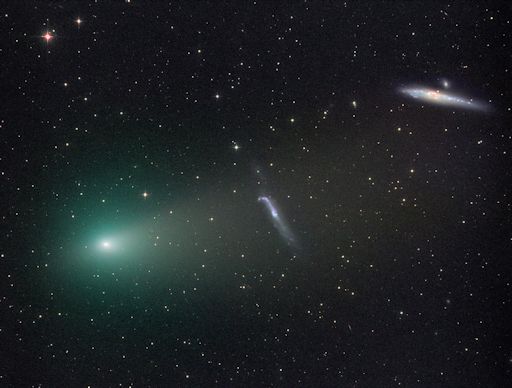
Located 25 million light years away, these two galaxies have been nicknamed by astronomers "The Whale and the Hockey Stick." The strange shape of the Hockey Stick is thought to result from a long-ago encounter with the Whale. No one can say exactly what happened. Probably the Whale's gravity probably pulled a plume of star forming gas from the body of the other galaxy, transforming the starry disk into something akin to a bent stick. The official names of these star systems are NGC4656 and NGC4631.
More photos of this unusual flyby may be found in the Realtime Comet Photo Gallery. Enjoy!
GREEN MOUNTAINS IN NORWAY: During an outburst of Northern Lights, most people stare at the sky. Sometimes, however, it pays to look at the ground. "On Feb. 18th, the mountains around us turned green," reports Didier Van Hellemojt from Tromsø, Norway, more than 200 miles north of the Arctic Circle. "The snowy slopes reflected the color of the green auroras overhead."
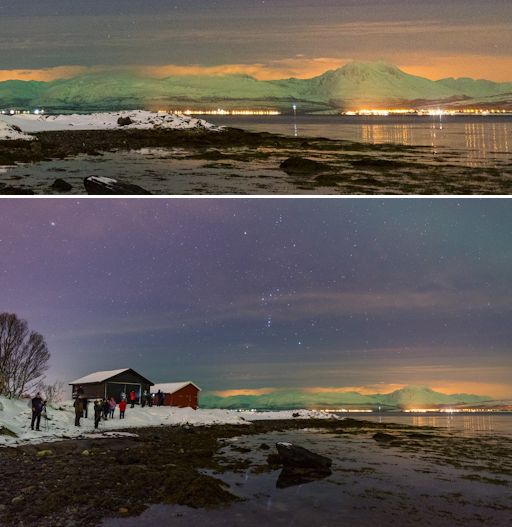
Green terrain could become a common sight in the nights ahead. Earth is inside a wide stream of solar wind that will influence our planet, off and on, for the rest of the month. Activity could reach a crescendo at the end of February when, according to NOAA analysts, G2-class geomagnetic storms could erupt around the Arctic Circle. Stay tuned for updates. Free: Aurora Alerts