SOLAR WIND ADVISORY: Solar wind speeds are expected to increase later today or (more likely) tomorrow when Earth enters a fast-moving stream of solar wind. First contact could trigger a G1-class geomagnetic storm (60% chance, according to NOAA) and bright auroras around the Arctic Circle. Free: Aurora Alerts

AURORA ROCKET LAUNCH: Early this morning, Feb. 22nd at 1 am local time in Alaska, researchers from Dartmouth University launched a rocket into the aurora borealis. Photographer Marketa Murray of Fairbanks had been waiting for the launch for 5 hours, and when she saw the distant glow of the rocket engines captured a perfectly-timed self-portrait:
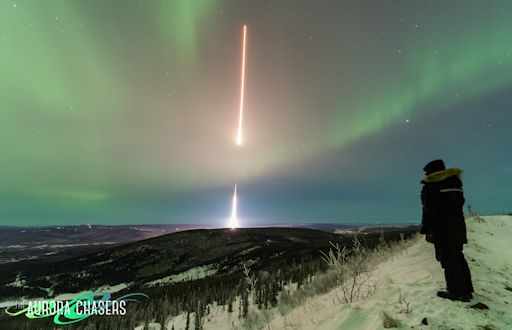
"We tuned into the Poker Flat Research Range radio for a heads-up that the rocket was about to launch," explains Murray. "The picture shows both stages of the Black Brant IX sounding rocket burning for the ionosphere."
"It was a lovely launch into a spectacular substorm, a perfect trajectory," says Dr. Kristina Lynch of Dartmouth College, the mission's principal investigator.
The goal of the mission, named ISINGLASS (Ionospheric Structuring: In Situ and Groundbased Low Altitude Studies) is to decipher the visual appearance of auroras. Auroras come in many forms, some look like flames, others like ripples or curtains. The rocket was launched to deploy an array of sensors into the auroral zone, mapping the particles and fields underlying these forms.
"Auroras are the last step of a chain of processes connecting the solar wind to the atmosphere," says Lynch. "We are seeking to understand what structure in these visible signatures can tell us about the electrodynamics of processes higher up."
Ultimately, such data could allow researchers to look up at the sky and, based on auroral forms they see with the unaided eye, predict conditions at the edge of space. Was the mission a success? Stay tuned for updates from the launch team.
SOLAR TORNADO OVER-ROTATES, EXPLODES: Yesterday, an explosion on the sun's eastern limb hurled a twisted plume of debris more than 250,000 km above the solar surface. NASA's orbiting Solar Dynamics Observatory recorded the blast:

An 8-hr movie recorded by extreme ultraviolet telescopes onboard the spacecraft shows what happened: A tornado of magnetized plasma became unstable when the twister twisted a bit too much. Magnetic fields crissed, crossed, and exploded in a process known as "magnetic re-connection." The flying debris will not hit our planet; the blast was too far off the sun-Earth line.
Realtime Space Weather Photo Gallery