SLIGHT CHANCE OF FLARES: Sunspot AR2638 has developed a 'beta-gamma' magnetic field that harbors energy for M-class solar flares. NOAA forecasters say there is a 5% chance of such an explosion on Feb. 24th. If an M-flare does occur, ham radio operators could experience shortwave blackouts; Earth-directed CMEs are also possible as the sunspot is almost directly facing our planet.
SOLAR WIND SPARKS AURORAS: Earth is moving deeper into a solar wind stream flowing from a hole in the sun's atmosphere. With wind speeds topping 600 km/s, the stream is buffeting our planet's magnetic field and sparking bright auroras round the Arctic Circle. Frank Olsen sends this picture from Morfjord at Lofoten, Norway:

Click here to see Olsen's complete panorama. "We expected a G1 show last night," he says. "It didn't quite reach that strength, but I was still quite satisfied with what we got."
NOAA forecasters say there is a 50-50 chance that G1-class magnetic storms will occur on Feb. 24th. That means the next photos could be even better. Monitor the realtime aurora gallery for sightings. Free: Aurora Alerts


POLLEN CORONAS: In parts of New Mexico, people are starting to sneeze--and see colorful rings around the sun. The two experiences are related. They are both manifestations of pollen. Photographer Harald Edens of Magdalena NM explains: "Every year in late February or early March, the juniper trees in New Mexico produce pollen. The pollen particles are all quite small and uniform in size; as a result, they scatter sunlight and produce colored rings around the sun."

"Today's pollen corona was by far the most intense I have observed in New Mexico over the past 14 years, with up to four orders (repeated color bands) readily visible to the unaided eye," Edens continues. "The pollen is so abundant that it appears like smoke coming off the juniper trees whenever there is a gust of wind, or a bird lands in a tree."
Readers, if you see a pollen corona, here's something else to look for: The colorful rings are not always circular. Pollens are non-spherical; many have air sacs to help carry them in the wind. These align the grains to give beautiful elliptical coronas with bright spots.
Realtime Space Weather Photo Gallery
AURORA ROCKET LAUNCH: On Feb. 22nd, shortly after midnight, bright green auroras erupted over Alaska's Poker Flat Research Range. Researchers from Dartmouth College promptly launched a rocket into the glowing maelstrom. Photographer Marketa Murray of Fairbanks captured the event in a perfectly-timed self-portrait:
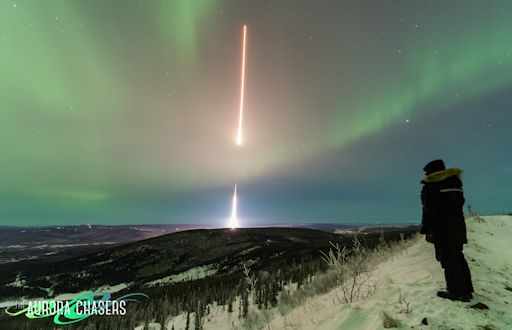
"We tuned into the Poker Flat Research Range radio for a heads-up that the rocket was about to launch," explains Murray. "The picture shows both stages of the Black Brant IX sounding rocket burning for the ionosphere."
The goal of the mission, named ISINGLASS (Ionospheric Structuring: In Situ and Groundbased Low Altitude Studies) is to decipher the mysterious shapes of the aurora borealis. Some auroras look like flames, others like swirls, ripples or curtains. The rocket was designed to scatter an array of sensors into the auroral zone, mapping the particles and fields underlying these forms.
"Auroras are the last step of a chain of processes connecting the solar wind to the atmosphere," says Dr. Kristina Lynch of Dartmouth, the mission's principal investigator. "We are seeking to understand what structure in these visible signatures can tell us about the electrodynamics of processes higher up."
"It was a beautiful launch with an extensive set of collaborative ground based data, and will make a great study," she says.
Ultimately, the results could allow researchers to look up at the sky and, based on little more than the shapes they see, predict conditions at the edge of space. Was the mission a success? Stay tuned for updates from the launch team.