CHANCE OF STORMS: NOAA forecasters estimate a 40% chance of polar geomagnetic storms late on Feb. 28th when the leading edge of a solar wind stream hits Earth's magnetic field. Arctic sky watchers should be alert for auroras as the month of March begins. Free: Aurora alerts.
SOUTHERN HEMISPHERE SOLAR ECLIPSE: This morning in Santiago, Chile, the Moon passed in front of the sun, off-center, transforming the solar disk into a crescent. At first it seemed that no one would see it. "The clouds had no mercy," reports Patricio Leon, "but eventually a small clearing revealed the eclipse." He took this picture at 14:03 UT when the sun was 49% covered:

The eclipse was also visible in Brazil. Edson Luiz Duffeck Karlson of São José dos Pinhais, Paraná, saw it a bit differently, though. Instead of watching the event unfold overhead, he set up a simple pinhole projector and used it to cast an image of the crescent sun onto a painting in his home.

"The clouds, in this case, are brushstrokes of oil," he says. "I painted them myself."
This eclipse was special. In a narrow corridor cutting across the southern reaches of Chile and Argentina, and stretching across the Atlantic to Angola, the Democratic Republic of the Congo, and Zambia in Africa, the Moon crossed the sun dead-center. Yet it only covered 99% of the solar disk. This allowed a fiery ring of solar plasma to circumscribe the mountainous limb of the Moon--like this.
Did anyone see the "ring of fire"? Stay tuned for sightings.
Realtime Solar Eclipse Photo Gallery
ARCTIC SPACE REINDEER: The students of Earth to Sky Calculus are about to travel inside the Arctic Circle (Abisko, Sweden) for their first polar space weather balloon launch. To raise money for the trip, on Feb. 23rd they flew a payload-full of Arctic reindeer pendants to the edge of space:
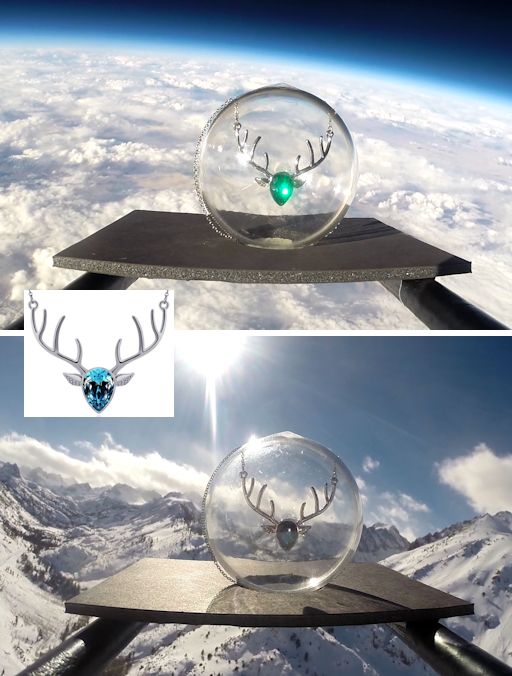
You can have one for $129.95. Each glittering pendant comes with a greeting card showing the jewelry in flight and certifying that it has been to the stratosphere and back again. These pendants make great Birthday and Mother's Day gifts.
Bonus: Would you like your pendant to be flown over the Arctic as well? Make a note to that effect in the COMMENTS box at checkout, and we will take your pendent to Sweden for a second trip to the stratosphere.
Realtime Space Weather Photo Gallery
AURORA ROCKET LAUNCH: On Feb. 22nd, shortly after midnight, bright green auroras erupted over Alaska's Poker Flat Research Range. Researchers from Dartmouth College promptly launched a rocket into the glowing maelstrom. Photographer Marketa Murray of Fairbanks captured the event in a perfectly-timed self-portrait:
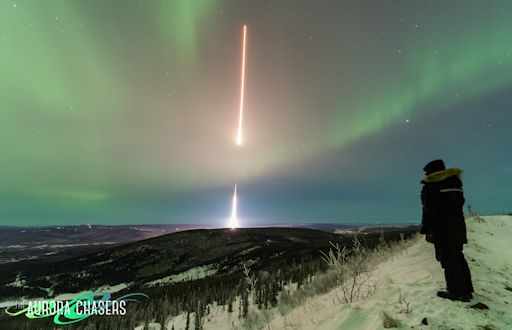
"We tuned into the Poker Flat Research Range radio for a heads-up that the rocket was about to launch," explains Murray. "The picture shows both stages of the Black Brant IX sounding rocket burning for the ionosphere."
The goal of the mission, named ISINGLASS (Ionospheric Structuring: In Situ and Groundbased Low Altitude Studies) is to decipher the mysterious shapes of the aurora borealis. Some auroras look like flames, others like swirls, ripples or curtains. The rocket was designed to scatter an array of sensors into the auroral zone, mapping the particles and fields underlying these forms.
"Auroras are the last step of a chain of processes connecting the solar wind to the atmosphere," says Dr. Kristina Lynch of Dartmouth, the mission's principal investigator. "We are seeking to understand what structure in these visible signatures can tell us about the electrodynamics of processes higher up."
"It was a beautiful launch with an extensive set of collaborative ground based data, and will make a great study," she says.
Ultimately, the results could allow researchers to look up at the sky and, based on little more than the shapes they see, predict conditions at the edge of space. Was the mission a success? Stay tuned for updates from the launch team.