SUNSET PLANETS: When the sun goes down tonight, step outside and look west. The skinny crescent Moon is approaching Venus for a side-by-side gathering on Feb. 28th. Got a small telescope? Point it at Venus. The planet has phases, and it is a crescent, too! Sky maps: Feb. 27, 28, Mar. 1.


SOLAR WIND, INCOMING: A canyon-shaped hole in the sun's atmosphere is spewing a stream of solar wind toward Earth. Polar geomagnetic storms could begin as early as Feb. 28th when the leading edge of the stream reaches our planet. NOAA forecasters estimate a 60% chance of G1-class storms on March 1st when Earth is fully enveloped by the fast-moving solar wind.

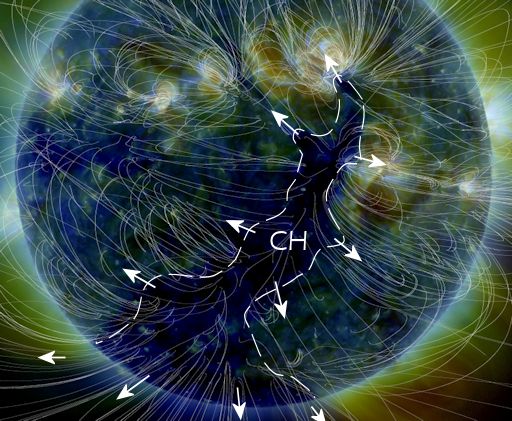
The source of the solar wind is a coronal hole (CH)--a region in the sun's atmosphere where the magnetic field opens up and allows solar wind to escape. NASA's Solar Dynamics Observatory photographed the structure, above, on Feb. 27th. Researchers call this a "negative-polarity" coronal hole because it contains south-pointing (that is, "negative") magnetic fields that tend to be very effective in causing geomagnetic storms when they reach Earth. Arctic sky watchers should be alert for bright auroras in the nights ahead. Free: Aurora alerts.
SOUTHERN HEMISPHERE SOLAR ECLIPSE: On Sunday, Feb. 26th, the Moon passed in front of the sun, off-center, transforming the solar disk into a crescent across much of Earth's southern hemisphere. Oleg Toumilovitch sends this picture from Johannesburg, South Africa:

"I caught the last moments of the eclipse just before sunset," says Toumilovitch.
While hundreds of millions of people witnessed a crescent sun, a much smaller number saw the "ring of fire." In a narrow path stretching across the southern reaches of South America and parts of Africa, the Moon passed directly in front of the sun, covering 99% of the solar disk. This allowed a fiery annulus of solar plasma to circumscribe the mountainous limb of the Moon.
Petr Horalek photographed the deep annular eclipse from Facundo, Argentina:

A full-sized image clearly shows the ring-shaped sun.

"What a wonderful experience," says Horalek. "In Patagonia, we witnessed the deep and incredibly short annular solar eclipse (duration about 47 sec.) in a blue sky with absolutely no cloud! The eclipse was so deep that the environment grew darker and all the shadows were drab. The place we chose was just a few dozens of meters from pleasant campsite, on the shore of small river close to Facundo village in Chubut, Argentina."
Realtime Solar Eclipse Photo Gallery
ARCTIC SPACE REINDEER: The students of Earth to Sky Calculus are about to travel inside the Arctic Circle (Abisko, Sweden) for their first polar space weather balloon launch. To raise money for the trip, on Feb. 23rd they flew a payload-full of Arctic reindeer pendants to the edge of space:

You can have one for $129.95. Each glittering pendant comes with a greeting card showing the jewelry in flight and certifying that it has been to the stratosphere and back again. These pendants make great Birthday and Mother's Day gifts.
Bonus: Would you like your pendant to be flown over the Arctic as well? Make a note to that effect in the COMMENTS box at checkout, and we will take your pendent to Sweden for a second trip to the stratosphere.
Realtime Space Weather Photo Gallery