SUNSET PLANETS: When the sun goes down tonight, step outside and look west. The skinny crescent Moon is shining alongside Venus in the twilight sky. Got a small telescope? Point it at Venus. The planet has phases, and it is a crescent, too! Sky maps: Feb. 28, Mar. 1.


SOLAR WIND, INCOMING: A canyon-shaped hole in the sun's atmosphere is spewing a stream of solar wind toward Earth. Polar geomagnetic storms could begin as early as Feb. 28th when the leading edge of the stream reaches our planet. NOAA forecasters estimate a 60% chance of G1-class storms on March 1st when Earth is fully enveloped by the fast-moving solar wind.

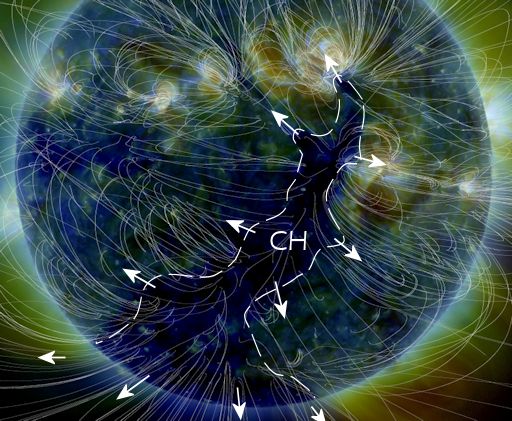
The source of the solar wind is a coronal hole (CH)--a region in the sun's atmosphere where the magnetic field opens up and allows solar wind to escape. NASA's Solar Dynamics Observatory photographed the structure, above, on Feb. 27th. Researchers call this a "negative-polarity" coronal hole because it contains south-pointing (that is, "negative") magnetic fields that tend to be very effective in causing geomagnetic storms when they reach Earth. Arctic sky watchers should be alert for bright auroras in the nights ahead. Free: Aurora alerts.
VENUS IS A CRESCENT: Lately, have you noticed an intensely bright star in the western sky at sunset? That's no star, it's a planet: Venus. And if you look at it with a small telescope, you might get another surprise. Venus is a crescent. Shahrin Ahmad of Kuala Lumpur, Malaysia, photographed the phenomenon on Feb. 28th:

"Venus now is shining at only 17.6%," says Ahmad. "We are only about 26 days before inferior conjunction."
Inferior conjunction is the reason for Venus's shape. On March 25th, Venus will pass almost directly between Earth and the sun--i.e., "inferior conjunction." As it approaches that point, Venus is turning its nightside toward Earth, leaving only a crescent-shaped sliver of dayside visible from our location on planet #3.
Amateur astronomers are encouraged to monitor Venus in the lead-up to inferior conjunction. In the nights ahead, the crescent of Venus will become increasingly thin and circular. The horns of the crescent might actually touch when the Venus-sun angle is least on March 25th. Stay tuned for that.
Realtime Solar Eclipse Photo Gallery
ARCTIC SPACE REINDEER: The students of Earth to Sky Calculus are about to travel inside the Arctic Circle (Abisko, Sweden) for their first polar space weather balloon launch. To raise money for the trip, on Feb. 23rd they flew a payload-full of Arctic reindeer pendants to the edge of space:

You can have one for $129.95. Each glittering pendant comes with a greeting card showing the jewelry in flight and certifying that it has been to the stratosphere and back again. These pendants make great Birthday and Mother's Day gifts.
Bonus: Would you like your pendant to be flown over the Arctic as well? Make a note to that effect in the COMMENTS box at checkout, and we will take your pendent to Sweden for a second trip to the stratosphere.
Realtime Space Weather Photo Gallery