LIVE AURORAS: "Massive auroras are dancing in the sky above us right now!" reports Chad Blakley of Abisko, Sweden. "The auroras started the moment the sun went down and, based on what we are seeing, we expect the rest of the evening to be a once in a lifetime kind of a night." Watch it live on an automated webcam in the Abisko National Park.
NORTHERN AND SOUTHERN LIGHTS: Today, G1-class geomagnetic storms are in progress as Earth moves through a stream of fast-moving solar wind. With wind speeds topping 700 km/s, bright auroras are circling both of Earth's poles. Taichi Nakamura photographed the Southern Lights from Crystals beach, Otago, New Zealand:


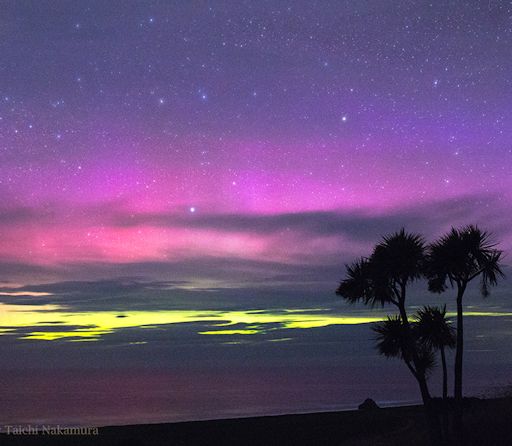
"I enjoyed this joyful view while sitting with one of my favorite Cabbage trees at the beach," says Nakamura.
Meanwhile, on the other end of the Earth, Northern Lights exploded over the frosty terrain of Tromsø, Norway:
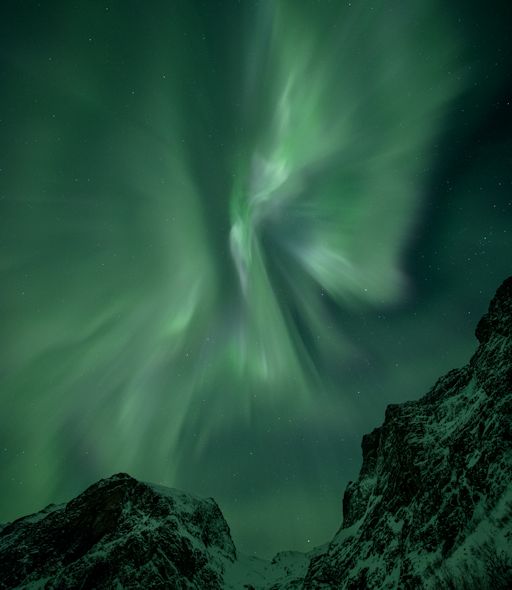
"Great impact tonight," says photographer Bernt Olsen. "We saw coronas overhead and lots of fast moving auroras."
The solar wind is flowing from a large canyon-shaped hole in the sun's atmosphere and is expected to influence Earth for the next two days. Polar sky watchers should remain alert for auroras on Mar. 2nd as NOAA forecasters estimate a 60% chance of continued geomagnetic storms. Free: Aurora alerts.

A NEW KIND OF SPACE WEATHER BALLOON: The students of Earth to Sky Maritime (a franchise of Earth to Sky Calculus) have built a space weather balloon payload that does something new: it floats. On Feb. 14th, they launched an experimental pipe-shaped payload from Calistoga, California. After a 2.5 hour trip to the stratosphere, the floating cylinder parachuted back to Earth and splashed down in the San Pablo Bay northeast of San Francisco.
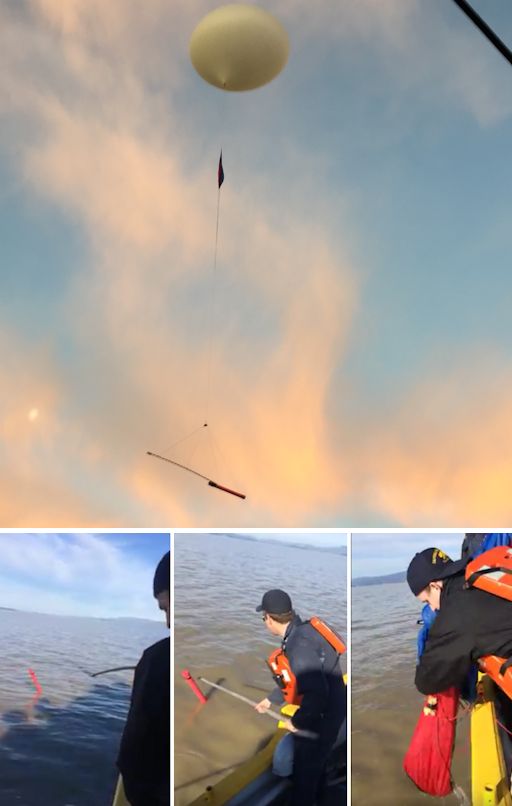
Guided by radar and GPS trackers, student mariners recovered the payload from the deck of the Cub, a tug boat operated by Cal Maritime. Not everything went perfectly. The payload's camera popped off at the moment of landing and sank to the bottom of the Bay--so no images from the stratosphere. Otherwise, the launch, tracking and recovery were a big success.
This development will allow us to start launching space weather balloons from places on Earth where the possibility of a water landing previously forbid such missions. The students of Earth to Sky Maritime already have one such place in mind: South Carolina during the August 21, 2017, total solar eclipse. They plan to photograph the eclipse from the stratosphere over Charleston and recover the payload later from the Atlantic after the Moon's shadow passes by.
Realtime Solar Eclipse Photo Gallery
Realtime Space Weather Photo Gallery