THE SOLAR WIND CONTINUES TO BLOW: Solar wind speeds are topping 700 km/s on March 3rd as Earth continues its 3-day journey through a stream of gaseous material flowing from a hole in the sun's atmosphere. This is sparking geomagnetic storms and beautiful auroras around the Arctic Circle. Rayann Elzein took this picture last night from Inari, Finland:


"The solar wind continues!" says Elzein. "Auroras were visible on the evening of March 2nd as soon as the sky became dark. Very strong auroras filled the sky. I quickly lost count of all the bright bands and fast coronas that appeared above us."
The display Elzein witnessed took place during a relatively minor G1-class magnetic storm. One night earlier, March 1st, an even stronger G2-class storm occurred, "and the auroras were epic," reports M-P Markkanen, who photographed the lights spilling over a 1356m high mountain called Otertinden in Storfjord, Norway:

"I spent most of the night admiring this dramatic mountain under the storming auroras, which danced on and off all night long with several crazy coronas!" says Markkanen.
Arctic sky watchers should be alert for more auroras tonight. NOAA forecasters estimate a 40% chance of polar geomagnetic storms on March 3rd as the solar wind continues to blow. Free: Aurora alerts.
WHY ARE WE GOING TO SWEDEN? Spaceweather.com is going to Sweden--and we're taking a team of student researchers from Earth to Sky Calculus with us. For a week beginning on March 9th we plan to launch a series of space weather balloons equipped with cosmic ray sensors and cameras into the stratosphere above the Arctic Circle. At the same time, Earth to Sky launch teams in Chile and California will be sending up identical payloads, forming an intercontinental balloon network:

We're doing this for three reasons:
1. To understand Earth's changing radiation environment: Regular monitoring of the stratosphere over California shows that cosmic rays have intensified more than 10% since 2015. Because of a recent decline in the solar cycle, more and more cosmic rays are reaching the inner solar system and penetrating the atmosphere of our planet. Earth's magnetic field should protect us against these rays, but geomagnetism is weakening. Globally, Earth's magnetic field has declined in strength by 10% since the 19th century with changes accelerating in recent years, according to measurements by Europe's SWARM satellites. To understand Earth's global response to these changes, we must launch balloons and sample radiation from widely-spaced locations. The upcoming network launch will span three continents, more than 14,000 km of linear distance, and 90+ degrees of latitude.
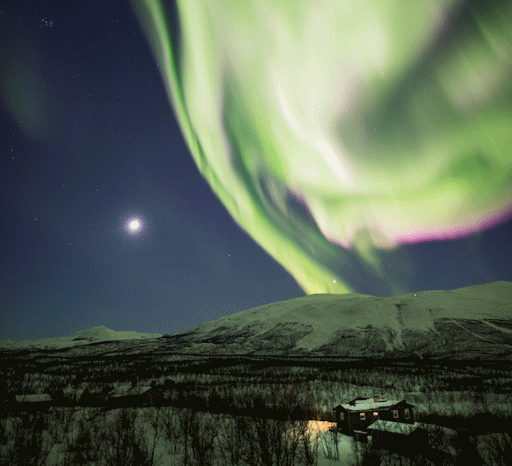
Above: Auroras over Abisko, Sweden, on Mar. 3rd. Credit: Peter Rosén/Lappland Media
2. To photograph the Northern Lights: We will be launching balloons from Abisko, Sweden, 250 km inside the Arctic Circle. Abisko is famous for spectacular auroras. One of our payloads will carry a low-light camera capable of photographing these lights from the stratosphere. Even at 120,000 feet, the balloon will be well below the auroras, but we will be a lot closer than any camera on the ground.

Above: Polar stratospheric clouds over Kiruna, Sweden, on Feb. 14. Credit: Mia Stålnacke
3. To sample polar stratospheric clouds: During winter months, the stratosphere above the Arctic Circle sometimes fills with icy clouds so colorful, they are likened to the aurora borealis. Polar stratospheric clouds (PSCs) are a sign of extremely cold temperatures in the stratosphere and some types of PSCs are responsible for ozone destruction. Our space weather balloons can fly right through these clouds, sampling their temperature, pressure, and ambient levels of radiation. We can also photograph them from the inside--a possible first!
Stay tuned for daily updates beginning March 9th.
Realtime Space Weather Photo Gallery
Realtime Solar Eclipse Photo Gallery