THE WORM MOON: There's a full Moon tonight, and according to folklore it has a special name: the Worm Moon. It signals the coming of northern spring, a thawing of the soil, and the first stirrings of earthworms in long-dormant gardens. Step outside tonight and behold the wakening landscape. "Worm moonlight" is prettier than it sounds. [photo gallery]
AURORAS VS. THE FULL MOON: For the next few nights, sky watchers around the Arctic Circle may have trouble seeing the aurora borealis. Only a bright outburst of lights could compete with the full Moon. On March 11th in Saariselka, Finland, such an outburst did occur:
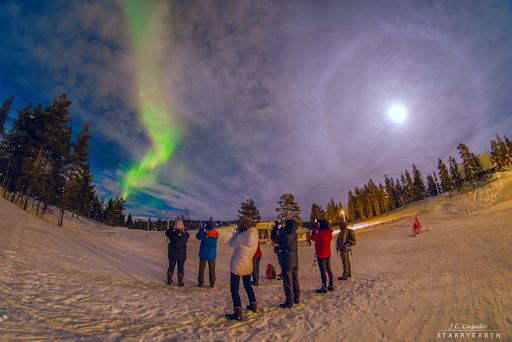
"A brief but intense display of auroras was well visible despite the moonlight," reports photographer Juan Carlos Casado. "We also witnessed a beautiful Moon halo."
While the auroras were caused by the gentle buffeting of solar wind thousands of kilometers above Earth's surface, the Moon halo is a sign of something much closer to the ground: ice crystals. Plate-shaped crystals floating in clouds 5 to 10 km overhead catch rays of moonlight and bend them into a 22o ring, as shown above.
The forecast this weekend calls for lots of Moon halos, but not so many auroras. NOAA forecasters say the chance of geomagnetic storm on March 12th is only 5%, so outbursts like Casado observed are unlikely. Meanwhile, the chance of a full Moon is 100%.
NEUTRONS ON A PLANE: Want to experience space weather? It's easy. Just step on board an airplane. Cosmic rays from deep space penetrate Earth's atmosphere where air travelers absorb them during long trips. On March 9th, the students of Earth to Sky Calculus flew to Sweden for an Arctic space weather balloon launch. During the flight from Los Angeles to Stockholm, they used a bubble chamber to search for neutrons--and they found them. In this photo, each bubble (three are circled for illustration) shows where a neutron passed through the chamber and vaporized a superheated droplet:

Among researchers it is well known that neutrons are an important form of cosmic rays, providing much of the biologically effective radiation dose at altitudes of interest to aviation and space tourism. Low-energy neutrons also cause single-event upsets in aircraft avionics.
By counting the bubbles in the chamber, it is possible to estimate the total dose of neutron radiation during our flight. The answer is 18 uSv--even more than the dose of X-rays and gamma-rays, which the students also measured. Lesson: When measuring aviation radiation, don't forget the neutrons! Stay tuned for more results from our ongoing research trip to the Arctic Circle.
Realtime Space Weather Photo Gallery
NORTHERN LIGHTS SPACE PENDANT: To raise money for their trip to the Arctic Circle, on March 2nd the students of Earth to Sky Calculus flew a payload-full of Northern Lights pendants to the edge of space above California. You can have one for $69.95. Each piece of jewelry comes with a greeting card telling the story of the pendant's trip to the stratosphere and certifying its peak altitude: 112,200 feet above Earth's surface.

Bonus: Would you like your pendant to fly above the Arctic Circle as well? Make a note in the COMMENTS box at checkout and we will take your pendant to Sweden for a second trip to the stratosphere.
More far-out gifts may be found in the Earth to Sky Store. All proceeds support STEM education and high-altitude ballooning.
Realtime Space Weather Photo Gallery