SUNSPOT COUNTS REACH 7-YEAR LOW: The sun has now been blank (no sunspots) for 14 consecutive days. To find a similar stretch of blank suns in the historical record, you have to go back to April of 2010--a time when the sun was emerging from a deep Solar Minimum. The current stretch of spotlessness heralds a new Solar Minimum expected to arrive in 2019-2020. Between now and then we can expect even longer interregnums broken from time to time by mostly small sunspots incapable of strong flares. Is space weather coming to an end? On the contrary, now is when things get interesting: Solar Minimum brings extra cosmic rays, pink auroras, and more.
TWINKLE, TWINKLE, CRESCENT VENUS: Like the Moon, Venus has phases, and right now it is a beautifully slender crescent. On March 17th, Italian astronomer Raffaello Lena used a small telescope to track Venus down to the horizon as it set in the evening sky of Rome. He recorded a beautiful example of atmospheric turbulence distorting the curved lines of the second planet:
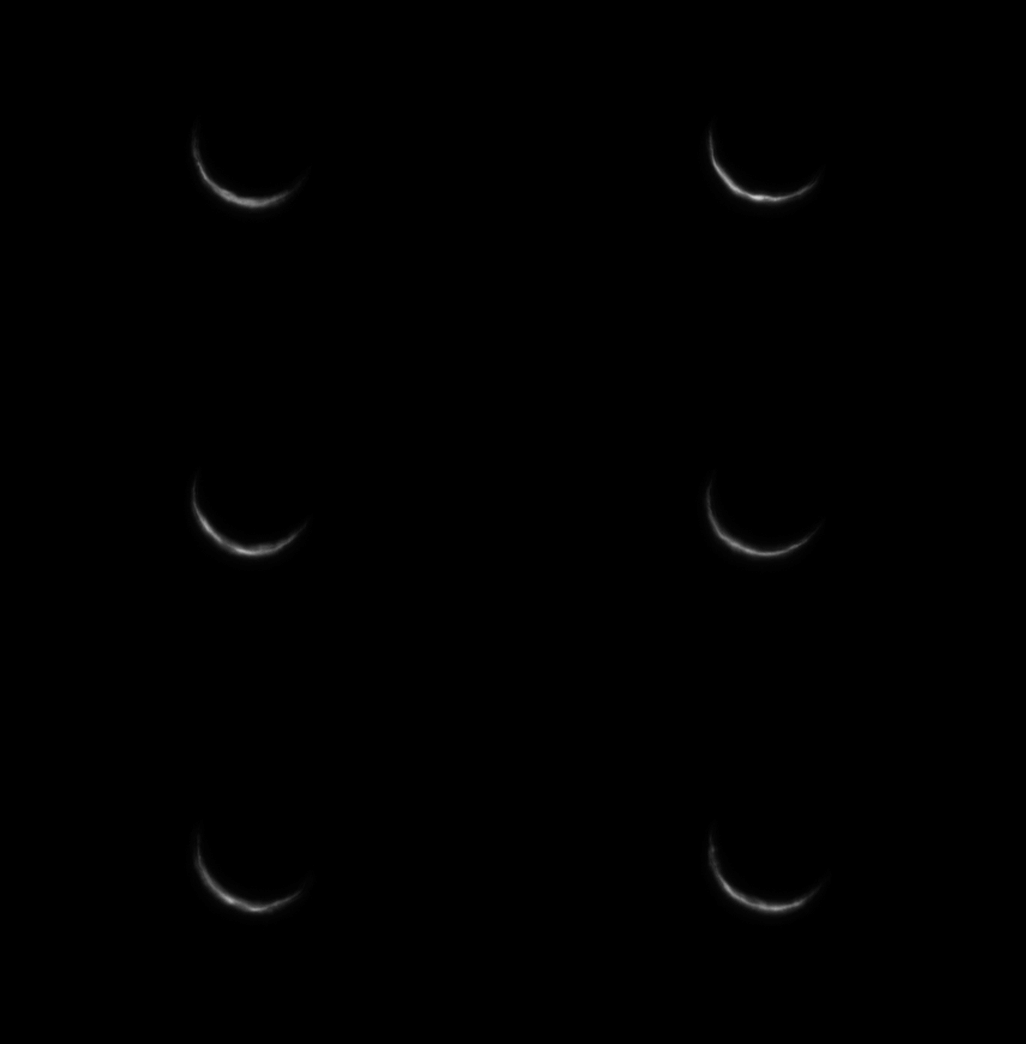
This kind of scintillation is normally reserved for pinpoint objects like distant stars. Venus is so thin, it's doing it too. In a related development, some observers have recorded the chromatic splitting of Venus into red, green, and blue crescents, making Venus look like a tiny rainbow in space.
All of this is happening because Venus is passing between Earth and the sun--an event astronomers call "inferior solar conjunction." As Venus turns its night side to Earth, only a luminous sliver remains. Observers can find Venus shining through the twilight in the western sky at sunset. The crescent is easy to see in small telescopes and binoculars.
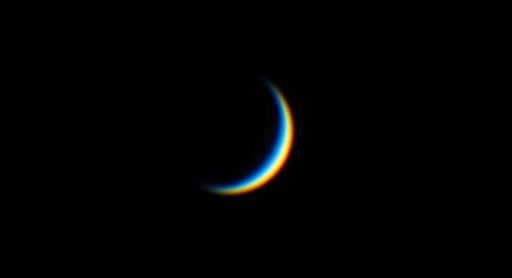
Above: "Rainbow Venus" photographed by Kevin R. Witman of Cochranville PA [more]
The Venus-sun distance will be least on March 25th. This is the most beautiful time to observe Venus, but also the most perilous. The glare of the nearby sun magnified by a telescope can damage the eyes of anyone looking through the eyepiece.
Anthony J. Cook of the Griffith Observatory has some advice for observers: "I have observed Venus at conjunction, but only from within the shadow of a building, or by adding a mask to the front end of the telescope to fully shadow the optics from direct sunlight. This is tricky with a refractor or a catadioptric, because the optics start at the front end of the tube. Here at Griffith Observatory, I rotate the telescope dome to make sure the lens of the telescope is shaded from direct sunlight, even through it means that the lens will be partially blocked when aimed at Venus. With our Newtonian telescope, I add a curved cardboard mask at the front end of the tube to shadow the primary mirror."
THE FLIGHT OF THE EASTERNAUTS: The cosmic ray monitoring program of Earth to Sky Calculus is not supported by government grants or big corporate sponsors. Instead we rely on you. That is, you and the Easternauts:
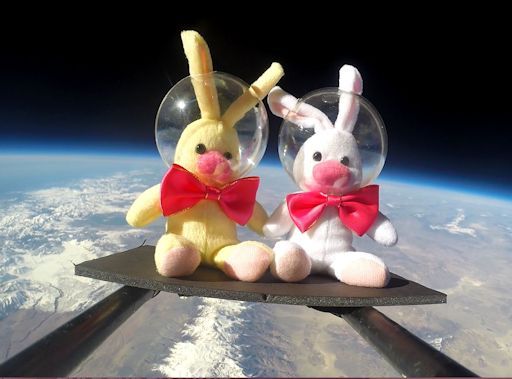
On March 2nd, the student researchers flew a payload-full of Easter bunnies to the edge of space--and you can have one for $39.95. (Space helmet included!) They make great Easter gifts for young scientists, and all proceeds support STEM education. Each bunny comes with a greeting card showing the Easternaut in flight and telling the story of its journey to the stratosphere and back again.
More far-out gifts may be found in the Earth to Sky store.
NEUTRONS ON A PLANE: Among researchers, it is well known that air travelers are exposed to cosmic rays. High-energy particles and photons from deep space penetrate Earth's atmosphere and go right through the hulls of commercial aircraft. This has prompted the International Commission on Radiological Protection (ICRP) to classify pilots and flight attendants as occupational radiation workers.
Many studies of this problem focus on ionizing radiation such as x-rays and gamma-rays. On March 16th we turned the tables and measured neutrons instead. During a 12-hour flight from Stockholm to Los Angeles, Spaceweather.com and the students of Earth to Sky Calculus used bubble chambers to monitor neutron activity inside a Scandinavian Airlines jetliner.

In the photo above, taken 35,000 feet above Greenland, each bubble shows where a neutron passed through the chamber and vaporized a superheated droplet. By the time the long flight was over, we measured almost 20 uSv (microsieverts) of radiation from neutrons--similar to the dose from a panoramic X-ray at your dentist's office. This confirms that neutrons are an important form of aviation radiation relevant to both air travelers and future space tourists.
Where do these neutrons come from? Mainly, they are secondary cosmic rays. When primary cosmic rays from deep space hit Earth's atmosphere, they produce a spray of secondary particles including neutrons, protons, alpha particles, and other species. Cosmic ray neutrons can reach the ground; indeed, researchers routinely use neutron counters on Earth's surface to monitor cosmic ray activity above the atmosphere. Now we're doing the same thing onboard airplanes.
Earlier in the week, we flew these bubble chambers to the Arctic stratosphere using a space weather balloon. Interestingly, the 12-hour plane flight yielded ~6 times more neutrons than the shorter (2 hour) but far higher (97,000 ft) balloon flight to the stratosphere. What does it mean? We're still analyzing the data and will have more insights to share in the days ahead. Stay tuned!
Realtime Space Weather Photo Gallery