GEOMAGNETIC STORM: A G1-class geomagnetic storm is underway on March 21st as a high-speed stream of solar wind buffets Earth's magnetic field. The stream is broad and Earth could remain inside it for the next three days. Arctic sky watchers should be alert for auroras shining through the waxing twilight of northern Spring. Free: Aurora Alerts

First contact with the solar wind stream on March 20th sparked a colorful display of auroras outside Fairbanks, Alaska:
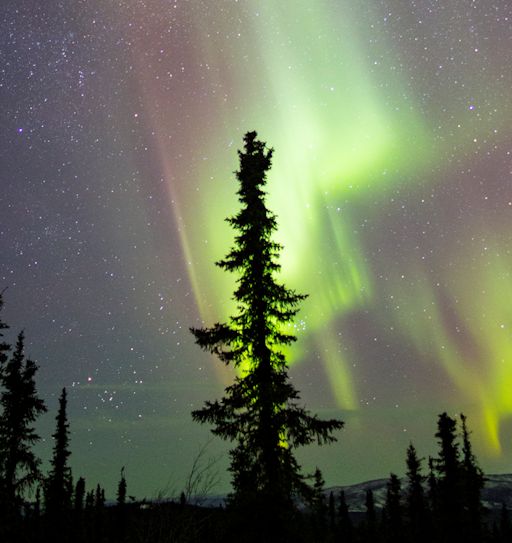
"The colors were so beautiful, and it was amazing to watch the curtains wave and change from moment to moment," reports photographer John Chumack. "Our crew enjoyed this dynamic display for many hours."
WHERE NO REINDEER HAS GONE BEFORE: The students of Earth to Sky Calculus have just returned from a week-long space weather ballooning campaign inside the Arctic Circle. To help pay for the trip, they launched a payload full of reindeer pendents to the edge of space--and you can have one for $129.95.
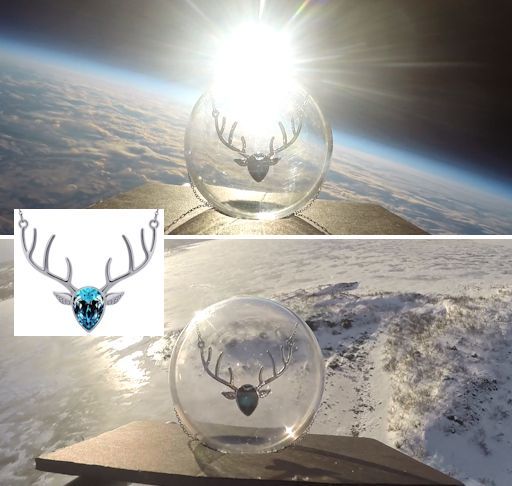
The pendants traveled to the Arctic stratosphere alongside an array of cosmic ray sensors. Launching from the frozen surface of Lake Torneträsk near Abisko, Sweden, the payload soared into a crystal-clear blue sky illuminated by the recently-risen springtime sun. Each glittering pendant comes with a greeting card showing the jewelry in flight and telling the story of its journey 97,000 feet above the Lapland of Northern Sweden.
More far-out gifts may be found in the Earth to Sky store.
Realtime Space Weather Photo Gallery
TWINKLE, TWINKLE, CRESCENT VENUS: Like the Moon, Venus has phases, and right now it is a beautifully slender crescent. On March 17th, Italian astronomer Raffaello Lena used a small telescope to track Venus down to the horizon as it set in the evening sky of Rome. He recorded a beautiful example of atmospheric turbulence distorting the curved lines of the second planet:
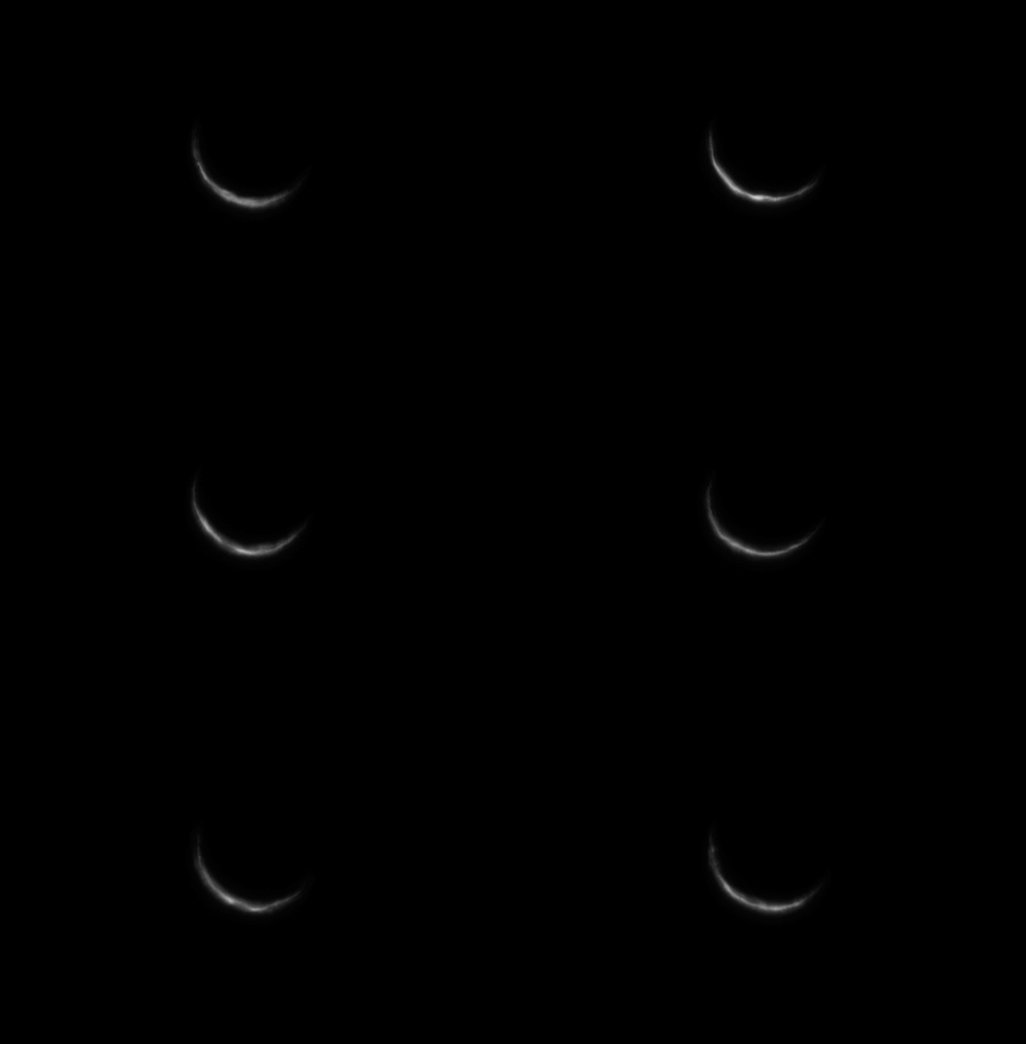
This kind of scintillation is normally reserved for pinpoint objects like distant stars. Venus is so thin, it's doing it too. In a related development, some observers have recorded the chromatic splitting of Venus into red, green, and blue crescents, making Venus look like a tiny rainbow in space.
All of this is happening because Venus is passing between Earth and the sun--an event astronomers call "inferior solar conjunction." As Venus turns its night side to Earth, only a luminous sliver remains. Observers can find Venus shining through the twilight in the western sky at sunset. The crescent is easy to see in small telescopes and binoculars.
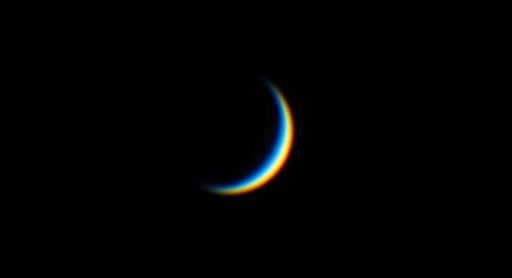
Above: "Rainbow Venus" photographed by Kevin R. Witman of Cochranville PA [more]
The Venus-sun distance will be least on March 25th. This is the most beautiful time to observe Venus, but also the most perilous. The glare of the nearby sun magnified by a telescope can damage the eyes of anyone looking through the eyepiece.
Anthony J. Cook of the Griffith Observatory has some advice for observers: "I have observed Venus at conjunction, but only from within the shadow of a building, or by adding a mask to the front end of the telescope to fully shadow the optics from direct sunlight. This is tricky with a refractor or a catadioptric, because the optics start at the front end of the tube. Here at Griffith Observatory, I rotate the telescope dome to make sure the lens of the telescope is shaded from direct sunlight, even through it means that the lens will be partially blocked when aimed at Venus. With our Newtonian telescope, I add a curved cardboard mask at the front end of the tube to shadow the primary mirror."