GRAB THE WINDOW SEAT: The solar wind currently blowing around Earth has quickened to 700+ km/s. This means auroras are likely around the Arctic Circle after local nightfall. High-latitude air travelers are already seeing Northern Lights just by looking out of north-facing windows in their planes. If you're flying North this week, window seats are highly recommended! Free: Aurora Alerts
SOLAR WIND SPARKS AURORAS: A hole in the sun's atmosphere is spewing solar wind toward Earth and, as a result, the Arctic Circle is glowing with bright auroras. Last night in Abisko, Sweden, "a corona burst through the clouds overhead," reports tour guide Oliver Wright. "It was bonkers--like looking into a black hole." He snapped this picture from the frozen shore of Lake Torneträsk:

"I've seen a lot of auroras this season," he says, "but seeing such a display on the Spring equinox was fairly special."
The show's not over. Solar wind speeds are topping 700 km/s on March 22nd as Earth moves deeper into the gaseous stream. The action of the wind is expected to continue for 2 to 3 more days, with a 50% to 60% chance of G1-class geomagnetic storms between now and March 24th. Arctic sky watchers should remain alert for auroras. Free: Aurora Alerts

EXQUISITE CRESCENT: This week, Venus is passing between Earth and the sun and, by doing so, turning its night side toward Earth. At the moment, all we can see of Venus is an exquisitely slender crescent. Maximilian Teodorescu photographed the second planet's shape from Magurele, Romania:

"Venus was lovely today at 200x thorough my 14 inch telescope," says Teodorescu. "Despite the mostly poor seeing, the superb thin crescent of Venus was a truly fantastic sight."
The Venus-sun distance will be least on March 25th (only 8.5 degrees)--a moment astronomers call "inferior solar conjunction." This is the most beautiful time to observe Venus, but also the most perilous. The glare of the nearby sun magnified by a telescope can damage the eyes of anyone looking through the eyepiece.
Anthony J. Cook of the Griffith Observatory has some advice for observers: "I have observed Venus at conjunction, but only from within the shadow of a building, or by adding a mask to the front end of the telescope to fully shadow the optics from direct sunlight. This is tricky with a refractor or a catadioptric, because the optics start at the front end of the tube. Here at Griffith Observatory, I rotate the telescope dome to make sure the lens of the telescope is shaded from direct sunlight, even through it means that the lens will be partially blocked when aimed at Venus. With our Newtonian telescope, I add a curved cardboard mask at the front end of the tube to shadow the primary mirror."
THE FLIGHT OF THE EASTERNAUTS: The cosmic ray monitoring program of Earth to Sky Calculus is not supported by government grants or big corporate sponsors. Instead we rely on you. That is, you and the Easternauts:
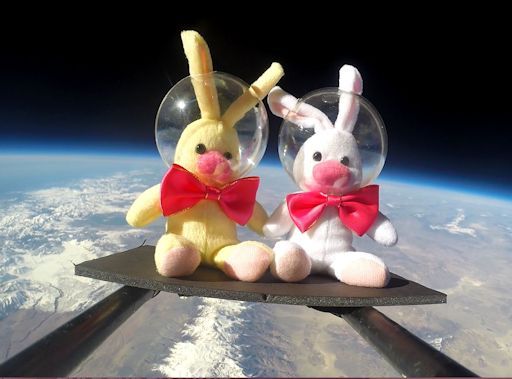
On March 2nd, the student researchers flew a payload-full of Easter bunnies to the edge of space--and you can have one for $39.95. (Space helmet included!) They make great Easter gifts for young scientists, and all proceeds support STEM education. Each bunny comes with a greeting card showing the Easternaut in flight and telling the story of its journey to the stratosphere and back again.
More far-out gifts may be found in the Earth to Sky store.
Realtime Space Weather Photo Gallery