CHANCE OF STORMS: NOAA forecasters estimate a 50% chance of polar geomagnetic storms on March 24th as Earth moves through a fast-moving stream of solar wind. Arctic sky watchers should remain alert for auroras in the waxing twilight of Northern spring. Free: Aurora Alerts
INFERIOR CONJUNCTION OF VENUS: Today and tomorrow, Venus is passing almost directly between Earth and the sun. With the planets so aligned, the night side of Venus is facing Earth and only a narrow sliver of Venus' sunlit hemisphere is visible. This has turned the second planet into an exquisitely slender crescent:

Ofer Gabzo sends this picture from the Givatayim Observatory in Israel. "Venus was passing just 9° north of the sun, and had turned its lovely thin crescent exactly to the south," says Gabzo. "Despite the angular proximity to the sun I did manage to get a glimpse of my favorite planet. The sun was obscured by the observatory's dome to avoid risking the camera and the telescope's optics."
Astronomers call this an "inferior conjunction of Venus." It is the most most beautiful time to observe Venus, but also the most perilous. Optics mis-pointed only slightly can catch the glare of the sun and focus its deadly rays onto vulnerable eyes. If you do try to observe Venus during inferior conjunction, take precautions like Gabzo did: Put the sun behind a tree or building and observe Venus from the safety of the shadows. Safer still is the Realtime Venus Photo Gallery.
FLYING TO THE AURORA AUSTRALIS: Last night, a group of sky watchers in Dunedin, New Zealand, boarded a plane and took off. They weren't heading to another airport. Instead, they flew south into the aurora australis. Taichi Nakamura took these pictures from a window seat in Economy Class:

"I was grateful to be on board the first chartered flight to 66 degrees south last night from 45.9 degrees south Dunedin New Zealand," says Nakamura. "Project name 'Flight to the Light' was a quest of aurora enthusiasts flying together to see the aurora more closely and was created by Dunedin's Otago museum director Ian Griffin. During the flight, we were rewarded with magnificent views of the aurora australis completely surrounding us providing us a breathtaking observatory of the Southern Lights."
A must-see video shows the lights in motion.
THE FLIGHT OF THE EASTERNAUTS: The cosmic ray monitoring program of Earth to Sky Calculus is not supported by government grants or big corporate sponsors. Instead we rely on you. That is, you and the Easternauts:
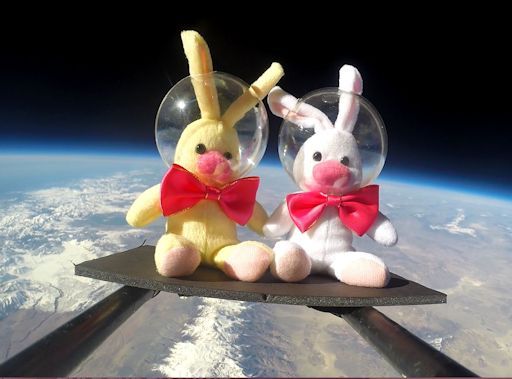
On March 2nd, the student researchers flew a payload-full of Easter bunnies to the edge of space--and you can have one for $39.95. (Space helmet included!) They make great Easter gifts for young scientists, and all proceeds support STEM education. Each bunny comes with a greeting card showing the Easternaut in flight and telling the story of its journey to the stratosphere and back again.
More far-out gifts may be found in the Earth to Sky store.
Realtime Space Weather Photo Gallery