POTENT CORONAL HOLE FACES EARTH: A canyon-shaped hole in the sun's atmosphere is facing Earth, and it is spewing a stream of fast-moving solar wind toward our planet. NASA's Solar Dynamics Observatory photographed the giant fissure on March 25th:

This is a "coronal hole" (CH) -- a vast region where the sun's magnetic field opens up and allows solar wind to escape. A gaseous stream flowing from this coronal hole is expected to reach our planet on during the late hours of March 27th and could spark moderately-strong G2-class geomagnetic storms around the poles on March 28th or 29th.

We've seen this coronal hole before. In early March, it lashed Earth's magnetic field with a fast-moving stream that sparked several consecutive days of intense auroras around the poles. The coronal hole is potent because it is spewing solar wind threaded with "negative polarity" magnetic fields. Such fields do a good job connecting to Earth's magnetosphere and energizing geomagnetic storms.
Arctic sky watchers should be alert for auroras early next week. Free: Aurora Alerts
INFERIOR CONJUNCTION OF VENUS: Today, March 25th, Venus is passing almost directly between Earth and the sun--an event astronomers call "inferior solar conjunction." As Venus passes by with its night side facing Earth, all we can see of the 2nd planet is a slender 1% crescent. Shahrin Ahmad photographed the curve earlier today from Tanjung Bidara, Melaka, Malaysia:

"Venus was a mere 8 degrees from the sun," says Ahmad. "This is my last view of Venus before it goes the other side of the sun and becomes a Morning Star."
Because Venus is so close to the sun, some observers are catching it very close to the horizon just after sunset. The turbulent low atmosphere of Earth has a disturbing effect on Venus' graceful curves. Consider this picture taken by Helio Vital on March 24th from Rio de Janeiro, Brazil:

"Earth's turbulent atmosphere acts like a dynamic set of moving lenses and prisms that play with the point-like light from the stars, causing their apparent brightness, color and even position to fluctuate or 'twinkle'," says Vital. "This effect is usually negligible for planets because the multiple beams of light we receive from their extended disks tend to cancel out. However, the current situation with Venus is different. Its crescent is so thin, each point along the crescent acts a bit like a star--twinkling colorfully as the planet sinks toward the horizon."
THE FLIGHT OF THE EASTERNAUTS: The cosmic ray monitoring program of Spaceweather.com and Earth to Sky Calculus is not supported by government grants or big corporate sponsors. Instead we rely on you. That is, you and the Easternauts:
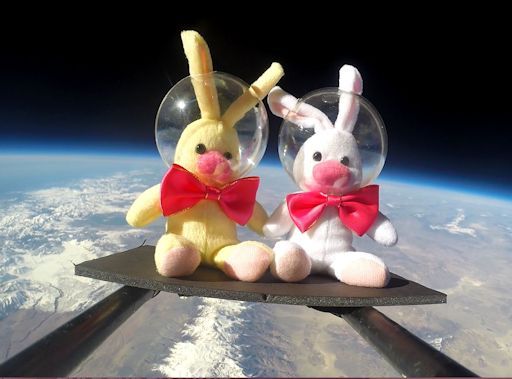
On March 2nd, the student researchers flew a payload-full of Easter bunnies to the edge of space--and you can have one for $39.95. (Space helmet included!) They make great Easter gifts for young scientists, and all proceeds support STEM education. Each bunny comes with a greeting card showing the Easternaut in flight and telling the story of its journey to the stratosphere and back again.
More far-out gifts may be found in the Earth to Sky store.
Realtime Space Weather Photo Gallery