SOLAR WIND CONTINUES TO BLOW: Minor G1-class geomagnetic storms are circling Earth's poles as our planet spends its 5th day inside a fast-moving stream of solar wind. Arctic and Antarctic sky watchers should remain alert for auroras after local nightfall. Free: Aurora Alerts

Sònia i Joan photographed this display on March 31st from Kabdalis in the Swedish Lapland:

"The auroras were bright and fast," says Joan. "We could see them even through the glare of headlights from passing cars."
APRIL 1ST COMET FLYBY: Green comet 41P/Tuttle-Giacobini-Kresak is flying over Earth's North Pole this week where sky watchers can find it all night long not far from the bowl of the Big Dipper. At closest approach on April 1st it will be just 21 million km from Earth--an easy target for backyard telescopes and almost visible to the naked eye. Amateur astronomer Yasushi Aoshima sends this picture of the approaching comet from Fukushima, Japan:
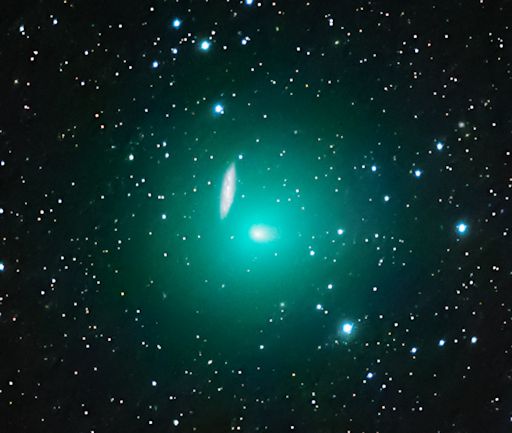
"On March 22nd I caught 41P 'eating' M108, the Surfboard Galaxy," says Aoshima. "The comet's green atmosphere appeared to swallow the distant spiral galaxy as it exited Ursa Major."
Why green? Like many comets, 41P has a verdant hue because its atmosphere contains diatomic carbon (C2)--a substance that glows green in the near vacuum of space.
Comet 41P is not only approaching Earth, but also the sun. April 12th is the date of perihelion (minimum distance from the sun). This means we are catching the comet just as solar heating is furiously searing its icy core. The green atmosphere should be well puffed up by streamers of vaporizing gas. Optimistic estimates of the comet's brightness place it at magnitude +6, near the lower limit of naked-eye visibility.
This is not a Great Comet, but it should be a good one. The best time to observe is during the dark hours before sunrise when the green fuzzball is high in the northern sky. If you have a GOTO telescope, you can point it using an ephemeris from the Minor Planet Center. These sky maps show approximately where to look: March 31, April 1, 2.


TOUCHING THE EDGE OF SPACE: On March 10, 2017, the students of Earth to Sky Calculus launched a space weather balloon from the frozen surface of Lake Tornetrask 250 km inside the Arctic Circle. A payload-full of reindeer pendants hitched a ride to the Edge of Space:
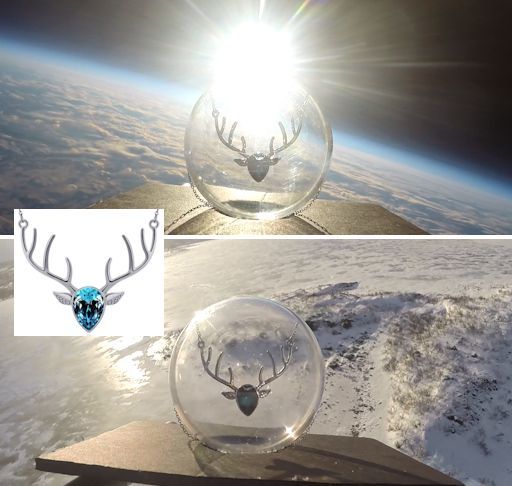
You can have one for $129.95. Each glittering pendant comes with a greeting card showing the jewelry in flight and telling the story of its journey 97,000 feet above the Lapland of Northern Sweden. They make great Birthday and Mother's Day gifts.
More far-out gifts may be found in the Earth to Sky store. All proceeds support STEM education and our atmospheric cosmic ray monitoring program.
SUNSPOT SUNSET: Sunspots AR2644 and AR2645 have grown so large that some sky watchers are noticing them as blemishes on the setting sun. Wednesday evening in Girona, Spain, photographer Mohamad Soltanolkotabi went outside to look at the crescent Moon and, when he faced west, captured the sunspots instead:
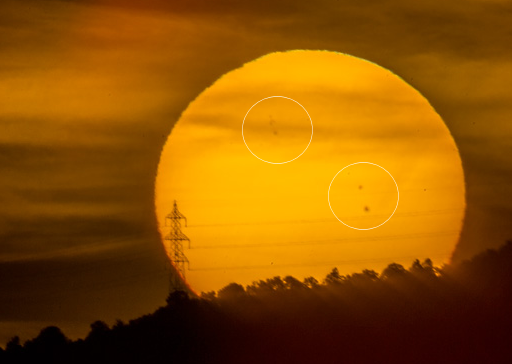
"The sun was dimmed by low-hanging clouds, which made it possible to photograph these two large sunspots," he explains. "I was located on the grounds of the University of Girona."
These sunspots are large, but not very active. Their magnetic fields are simple and stable, and thus pose little threat for explosive flares. Nevertheless they are photogenic. Warning: Even when the sun is dimmed by low-hanging clouds or smoke, it can still hurt your eyes. If you chose to photograph the low sun, as Soltanolkotabi did, use the camera's LCD screen for safe viewfinding. Never look into the eyepiece of an unfiltered camera or telescope when the sun is in the field of view.