APRIL 1ST COMET FLYBY: No kidding. This weekend, green comet 41P/Tuttle-Giacobini-Kresak is flying over Earth's northern hemisphere where sky watchers can find it all night long not far from the bowl of the Big Dipper. At closest approach on April 1st it will be just 21 million km from Earth--an easy target for backyard telescopes and almost visible to the naked eye. [photo gallery] [sky map] [ephemeris]

BIG SUNSPOT FACES EARTH: In a year of few sunspots, AR2645 is remarkable. The young spot has quickly grown from an almost invisible speck into a sprawling behemoth more than 120,000 km wide, with multiple dark cores larger than Earth. And, it is directly facing our planet:

AR2645 has a 'beta-gamma' magnetic field that harbors energy for M-class (moderately strong) solar flares. Any such explosions while the sunspot faces Earth could ionize the top of our planet's atmosphere and alter the normal propagation of radio transmissions around the globe. Shortwave radio blackouts are possible if the sunspot erupts.
Despite its potential, AR2645 has so far been quiet, emitting only a crackling of minor C-flares with minimum effect on Earth. NOAA forecasters estimate a 10% chance of more potent M-flares in the next 24 hours.
Realtime Space Weather Photo Gallery
PINK AURORAS: Earth's solar wind environment remains enhanced 6 days after our planet entered a stream of solar wind flowing from a canyon-shaped hole in the sun's atmosphere. The action of this wind stream is producing intermittent auroras around the poles--including this surge of pink last night in the Finnish Lapland:

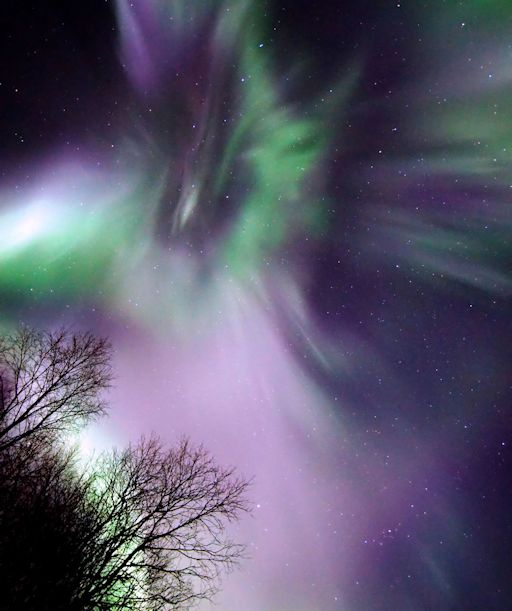
"Just before midnight, suddenly, we saw an enormous outburst of auroras," says photographer B.Art Braafhart. "This pink corona was the highlight of the show."
More Arctic auroras are possible in the nights ahead. In addition to the current solar wind stream, another lesser stream is due to arrive in the next 24 hours or so, adding its effect to the gaseous flow now surrounding Earth. NOAA forecasters estimate a 25% to 30% chance of G1-class geomagnetic on April 1st and 2nd.

FLIGHT OF THE EASTERNAUTS: The cosmic ray monitoring program of Spaceweather.com and Earth to Sky Calculus is not supported by government grants or big corporate sponsors. Instead we rely on you. That is, you and the Easternauts:
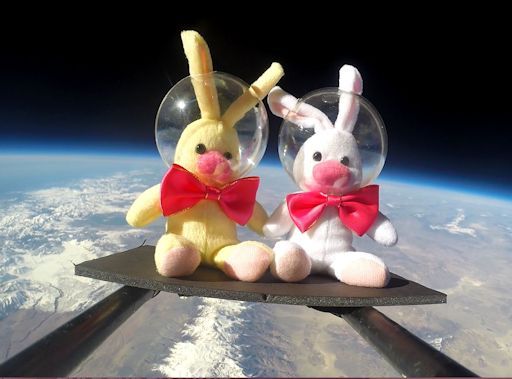
On March 2nd, student researchers flew a payload-full of Easter bunnies to the edge of space--and you can have one for $39.95. (Space helmet included!) They make great Easter gifts for young scientists. Each bunny comes with a greeting card showing the Easternaut in flight and telling the story of its journey to the stratosphere and back again.
More far-out gifts may be found in the Earth to Sky store. All proceeds support STEM education and our atmospheric cosmic ray monitoring program.