CHANCE OF FLARES: NOAA forecasters estimate a 60% chance of M-class solar flares and a 20% chance of X-flares on April 3rd as sunspot AR2644 continues to crackle with magnetic explosions. Extreme UV radiation from such flares can cause shortwave radio blackouts and other disturbances to the normal transmission of radio signals around the globe. Free: Solar Flare Alerts
THE SUN WAKES UP: Suddenly, solar flare activity is high. With little warning, sunspot AR2644 exploded on April 1st, producing an M4.4-class flare. That was the strongest solar flare of the year--for less than a day. The sunspot topped itself on April 2nd with a pair of M5-class explosions, followed by another M5-flare on April 3rd. The latest blast is shown here in a picture from NASA's Solar Dynamics Observatory:

Flashes of extreme ultraviolet radiation, like the one shown above, have been ionizing Earth's upper atmosphere and altering the normal propagation of radio waves around our planet. There have been at least four significant shortwave radio blackouts; blackout maps: #1, #2, #3, #4. People who might have noticed these blackouts include ham radio operators and mariners using low-frequency rigs for communication at frequencies below 10 MHz.


Update: This series of explosions hurled a number of coronal mass ejections (CMEs) into space. NOAA computer models confirm that none of them will hit Earth.
Realtime Space Weather Photo Gallery
SOLAR RADIO BURSTS: Yesterday's M4.4 solar flare from sunspot AR2644 flare caused a shortwave radio blackout. It also produced the opposite--a loud burst of radio static. In rural New Mexico, amateur radio astronomer Thomas Ashcraft recorded the hiss and crackle emerging from the loudspeaker of his receiver. Click to listen:
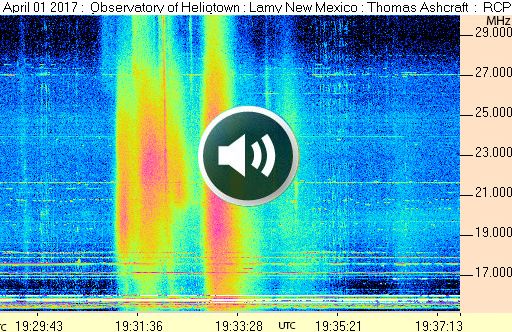
"The solar flare generated very strong emissions and nearly saturated my radio telescope," says Ashcraft. " The sound file was recorded at 21 MHz and it has three peaks."
Solar radio bursts are caused by solar flares. Electrons accelerated by strong flares race through the sun's atmosphere, causing a ripple of plasma waves and radio static. Astronomers classify solar radio bursts into five types; Ashcraft's recording captured a mixture of Type III and Type V.
"I had been thinking that I might not be receiving any more strong solar storms this cycle," says Ashcraft, "but am thrilled to receive this activity. And there might be more to come if AR2644 continues to flare."
Realtime Space Weather Photo Gallery
FLIGHT OF THE EASTERNAUTS: Looking for an Easter gift for a young scientist? Submitted for your consideration: The Easternauts. On March 2nd, the students of Earth to Sky Calculus flew a payload-full of Easter bunnies to the edge of space--and you can have one for $39.95. (Space helmet included!)
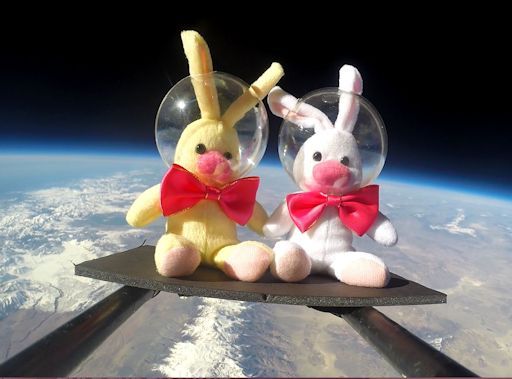
Carried aloft by a giant helium balloon, these plush bunnies went on a hare-raising journey more than 113,000 feet above Earth's surface. They encountered temperatures as low as -63 C and cosmic ray dose rates more than 100 times Earth normal. Each bunny comes with a greeting card showing the Easternaut in flight and telling the story of its journey to the stratosphere and back again.
More far-out gifts may be found in the Earth to Sky store. All proceeds support STEM education and our atmospheric cosmic ray monitoring program.