MINOR GEOMAGNETIC STORM: Beating low probabilities of magnetic activity, a minor G1-class geomagnetic storm erupted on April 4th, sparking bright auroras around the Arctic Circle. "I enjoyed the show with my kitty," says Ayumi Bakken, who sends this picture from Fairbanks, Alaska:

This unexpected storm started when the interplanetary magnetic field (IMF) near Earth tipped south. This opened a crack in Earth's magnetosphere. Solar wind poured in to fuel the display.
WHERE WILL THE NEXT FLARE COME FROM? Today, there are two sunspots that pose a threat for strong flares: AR2644 and AR2645. Both have unstable delta-class magnetic fields that harbor energy for M- and X-class explosions. Their locations are circled in this April 4th image of the sun from NASA's Solar Dynamics Observatory:

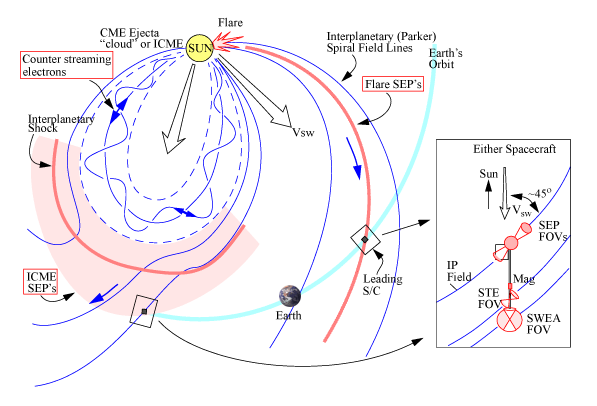
Sunspot AR2644 is of special interest. Since the month began, it has produced more than half-a-dozen M-class solar flares, with an equal number of shortwave radio blackouts on Earth. Moreover, this sunspot is magnetically well-connected to Earth. Look at this diagram. Magnetic fields spiraling back from AR2644's location on the sun's western limb lead almost directly to our planet. If AR2644 explodes today, energetic particles accelerated by the blast could be funneled toward Earth, producing a radiation storm above Earth's atmosphere.
NOAA forecasters estimate a 70% chance of M-class flares and a 25% chance of X-flares on April 4th. Free: Solar Flare Alerts
Realtime Space Weather Photo Gallery
ACCIDENTAL SATELLITE SPOTTED: Last Thursday, astronauts spacewalking outside the International Space Station (ISS) had an accident. Just as they were about to install a fabric shield to protect a portion of the station from micrometeoroid impacts ... oops ... the un-tethered shield floated away. On April 3rd, Marco Langbroek of Leiden, the Netherlands, spotted the accidental satellite zipping through the Big Dipper:

"The shield was 1 minute in front of the ISS when I made this image using my Canon EOS 60D digital camera," says Langbroek. "The two bright stars are kappa and iota Uma. "
Weighing about 18 pounds, the 3-inch thick shield measures 5 feet long by 2 feet wide. That's how much of the space station's surface was left exposed to micrometeoroid impacts. No problem. An article in the Washington Post describes how engineers at Mission Control brainstormed a replacement shield using supplies readily available on the ISS.The stray shield poses no threat to its mother ship. NASA says it is moving away from the ISS and already starting to experience orbital drag. "It will probably re-enter Earth's atmosphere in late summer of 2017," notes Langbroek.
Realtime Space Weather Photo Gallery
FLIGHT OF THE EASTERNAUTS: Looking for an Easter gift for a young scientist? Submitted for your consideration: The Easternauts. On March 2nd, the students of Earth to Sky Calculus flew a payload-full of Easter bunnies to the edge of space--and you can have one for $39.95. (Space helmet included!)

Carried aloft by a giant helium balloon, these plush bunnies went on a hare-raising journey more than 113,000 feet above Earth's surface. They encountered temperatures as low as -63 C and cosmic ray dose rates more than 100 times Earth normal. Each bunny comes with a greeting card showing the Easternaut in flight and telling the story of its journey to the stratosphere and back again.
More far-out gifts may be found in the Earth to Sky store. All proceeds support STEM education and our atmospheric cosmic ray monitoring program.