JUPITER AND THE MOON: After the sun goes down tonight, step outside and look east. You'll see Jupiter and the full Moon rising together in the constellation Virgo. Separated by only a few degrees, the brilliant pair will be up all night long--a beautiful sight. [sky map]

AURORA CASCADE: A "CIR" hit Earth's magnetic field on April 8th, and lit up the polar regions with colorful auroras. "We saw an incredible display despite the almost-full Moon," reports B.Art Braafhart of Salla in the Finnish Lapland. "A quiet green arch exploded into an amazing field with fast-moving red, green, yellow, pink, and violet."

"There was even a color I never saw before in the aurora color palette--something like beige-pink-violet," Braafhart says. "The duration of this corona explosion was only 5 minutes, but what an experience!"
CIRs (corotating interaction regions) are transition zones between fast- and slow-moving streams of solar wind. Magnetic fields from the sun pile up and intensify inside CIRs; when they reach Earth, they can connect and re-connect to our own planet's magnetic field. Magnetic reconnection is an explosive process that does a good job sparking bright auroras.
INCREDIBLE COMET TAIL: More than 180 million km from Earth, something is happening to Comet PanSTARRS (C/2015 ER61). On April 4th and 5th, the comet brightened more than 6-fold, from magnitude +8.5 to +6.5, suddenly reaching the verge of naked-eye visibility despite its great distance from our planet. Now amateur astronomers are photographing an incredible tail. Gerald Rhemann sends this picture from his private observatory in Farm Tivoli, Namibia:
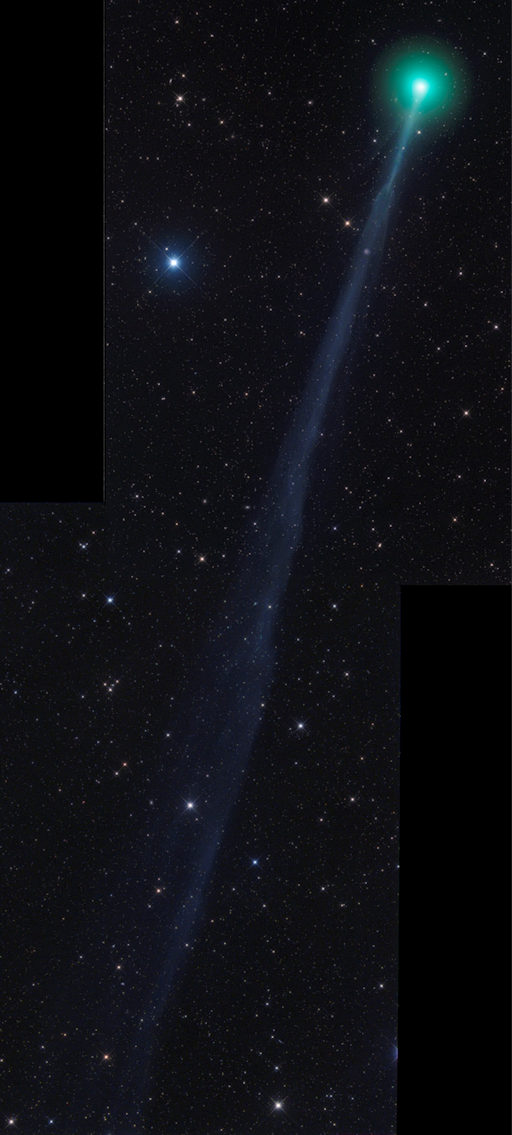
"The comet's tail is about 2.5 degrees long," says Rhemann.
That means it spans more than 8 million km. For comparison, the entire sun is 1.4 million km wide; you could wrap the comet's tail around the sun's equator twice. Another way of putting it: The distance from Earth to the Moon is only 5% of the length of the gaseous lane behind Comet PanSTARRS.
The comet's outburst is probably caused by a fresh vein of icy material in the comet's nucleus exposing itself to solar radiation. Furiously vaporizing, the comet's core is spewing jets of dust and gas into space--a tail-building process that should intensify as the comet approaches the sun between now and early May.
The comet's closest approach to Earth will be 176 million km (1.18 AU) on April 19th. Even at that distance, the comet might be a beautiful sight in backyard telescopes if current trends continue. Stay tuned!