NASA MAY HAVE TO BREAK RADIATION RULES TO GET TO MARS: As the sunspot cycle winds down, cosmic rays are intensifying throughout the solar system. If NASA wants to send astronauts to Mars through that thicket of radiation, the space agency may have to break some of its own safety rules. Get the full story from PBS/NOVA.
SOLAR FILAMENT EXPLODES, HURLS CME: On April 9th, a dark filament of magnetism on the sun rose up and hurled a portion of itself into space. NASA's Solar Dynamics Observatory recorded the eruption:
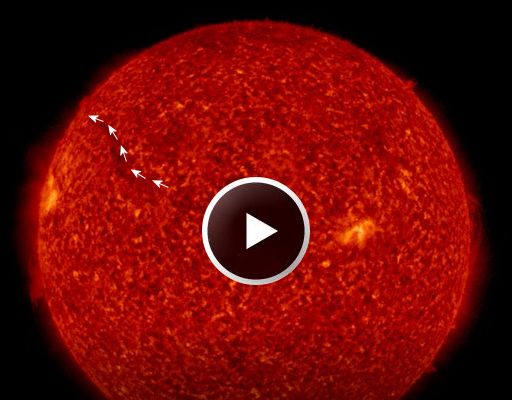
Flying debris from the filament formed the core of a coronal mass ejection (CME). A movie from the Solar and Heliospheric Observatory (SOHO) shows the cloud leaving the sun. At first it appeared that the CME would miss Earth, but a new analysis by NOAA forecasters suggests that a glancing glow is possible on April 14th. G1-class geomagnetic storms are possible when the CME arrives this weekend. Free: Aurora Alerts.


SPOILER ALERT--SHE SAID "YES": Last week, longtime Spaceweather.com reader Erik Rasmussen proposed to his girlfriend Amy in a very special way. "I asked her to close her eyes, while I put an image on the TV set," he explains. "When that was ready, I got down on one knee with the ring in my hand, and said open your eyes." This is what she saw:

Erik's proposal--complete with a keepsake bear and Earth charm--had flown to the edge of space onboard an Earth to Sky Calculus space weather balloon.
"When the realization of what was going on started to kick in, I asked her to marry me," says Erik. "Let's just say she was very excited and impressed at the efforts all of us put into the proposal." And, by the way, she said "yes."
In collaboration with Spaceweather.com, student researchers launch these balloons almost weekly to monitor cosmic rays in the atmosphere. (They're intensifying.) Erik donated $500 to sponsor a flight on March 19th.
"As a son of scientists, and a fan of astronomy/space exploration, I felt that this was a great way to propose and that my sponsorship dollars would be put to good use supporting the next generation of scientists," says Erik. "Thank you Earth to Sky for being a part of this epic moment in our life," adds Amy.
Readers, would you like to buy your own ticket to space? There's one waiting for you in the Earth to Sky Store.
INCREDIBLE COMET TAIL: More than 180 million km from Earth, something is happening to Comet PanSTARRS (C/2015 ER61). On April 4th and 5th, the comet brightened more than 6-fold, from magnitude +8.5 to +6.5, suddenly reaching the verge of naked-eye visibility despite its great distance from our planet. Now amateur astronomers are photographing an incredible tail. Gerald Rhemann sends this picture from his private observatory in Farm Tivoli, Namibia:
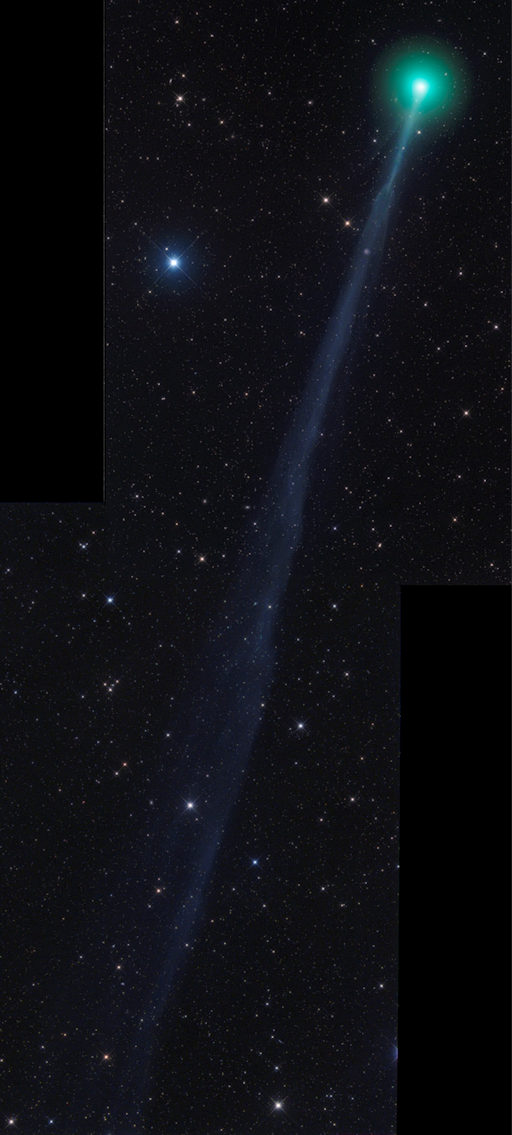
"The comet's tail is about 2.5 degrees long," says Rhemann.
That means it spans more than 8 million km. For comparison, the entire sun is 1.4 million km wide; you could wrap the comet's tail around the sun's equator twice. Another way of putting it: The distance from Earth to the Moon is only 5% of the length of the gaseous lane behind Comet PanSTARRS.
The comet's outburst is probably caused by a fresh vein of icy material in the comet's nucleus exposing itself to solar radiation. Furiously vaporizing, the comet's core is spewing jets of dust and gas into space--a tail-building process that should intensify as the comet approaches the sun between now and early May.
The comet's closest approach to Earth will be 176 million km (1.18 AU) on April 19th. Even at that distance, the comet might be a beautiful sight in backyard telescopes if current trends continue. PanSTARRS is currently in the pre-dawn sky, gliding through the constellation Capricornus en route to Aquarius. Its location in the Zodiac favors southerners, but observers in both hemispheres can see the comet. If you have a GOTO telescope, use this ephemeris to point your optics. Sky maps and more information are available here and here.