LYRID METEOR SHOWER: Earth is entering a stream of debris from Comet Thatcher, source of the annual Lyrid meteor shower. Tonight and tomorrow, dark sky observers could see 10 to 20 shooting stars per hour. The best time to look is during the hours before dawn when the constellation Lyra is high in the sky. [sky map]

SURPRISE! EARTH DAY AURORA STORM: Last night, Northern Lights descended into the United States as far south as Michigan, Minnesota, and Washington, kicking off an unexpected display of bright auroras for Earth Day. Both ends of our planet started to glow as the magnetic storms intensified. Cindy Ballantyne sends this picture from the Otago Peninsula in New Zealand:

What happened? A bright CME that left the sun on April 19th was supposed to miss Earth. Instead, it hit, delivering a glancing blow that surprised forecasters.

The show's not over. G1 and G2-class geomagnetic storms are underway on April 22nd as Earth moves through the CME's magnetized wake. High-latitude sky watchers should remain alert for midnight auroras on April 22-23. Free: Aurora Alerts


THESE PENDANTS HAVE TOUCHED SPACE: These pendants have touched space--and returned to Earth in time for Mother's Day. On April 15, 2017, the students of Earth to Sky Calculus flew a payload-full of heart-shaped Venus pendants to the stratosphere onboard a high-altitude helium balloon. Here's one, 111,550 feet above the Sierras of central California:
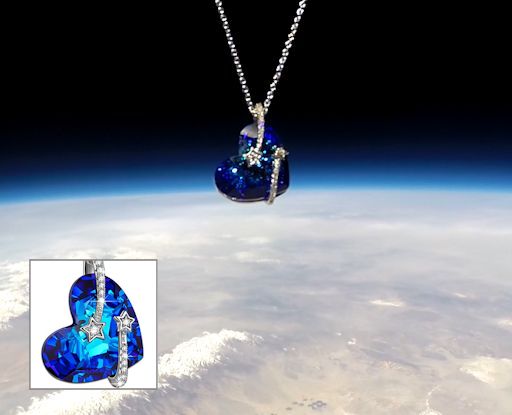
These blue jewels make great Mother's Day gifts--and you have have one for $99.95. Each glittering pendant comes with a greeting card showing the jewelry in flight and telling the story of its journey to the stratosphere and back again.
More far-out Mother's Day gifts may be found in the Earth to Sky Store. All proceeds support atmospheric radiation monitoring and hands-on STEM education.
POTENT CORONAL HOLE TURNS TOWARD EARTH: A large hole in the sun's atmosphere is turning toward Earth, and it is spewing a stream of fast-moving solar wind toward our planet. NASA's Solar Dynamics Observatory photographed the giant fissure on April 21st:

This is a "coronal hole" (CH) -- a vast region where the sun's magnetic field opens up and allows solar wind to escape. Gaseous material flowing from this coronal hole is expected to reach our planet on April 23rd or 24th and could spark moderately-strong G2-class geomagnetic storms. NOAA forecasters say the odds of a magnetic storm is 75%.
We've seen this coronal hole before. On March 27th it lashed Earth's magnetic field with a fast-moving stream that ignited intense auroras around both of Earth's poles. The coronal hole is potent because it is spewing solar wind threaded with "negative polarity" magnetic fields. Such fields do a good job connecting to Earth's magnetosphere and energizing geomagnetic storms. Free: Aurora Alerts
Realtime Space Weather Photo Gallery