CRESCENT SUPERMOON: In recent years, we've heard a lot about supermoons--full Moons that are extra big and bright because they occur on the perigee side of the Moon's elliptical orbit. Now, let us introduce you to the crescent supermoon. On Thursday, April 27th, the crescent Moon occurs at perigee, making it as much as 14% wider and 30% brighter than other crescent Moons of the year. To find it, you'll have to look deep into the rosy glow of sunset:


Amir Shahcheraghian photographed this sledar crescent from Qeshm, Iran, in Dec. 2016. At the time, the Moon was about 1 day past New. Thursday's equally young Moon will be a little bigger, a little brighter, and super beautiful. Tip: Binoculars may help you find this skinny supermoon in the bright glow of sunset. However, do not point your optics at the sun! Got pictures? Submit them here.
Realtime Space Weather Photo Gallery
THESE PENDANTS HAVE TOUCHED SPACE: These pendants have touched space--and returned to Earth in time for Mother's Day. To support their cosmic ray monitoring program, the students of Earth to Sky Calculus flew a payload-full of jewelry to the stratosphere onboard a high-altitude helium balloon. Here's one of the pendants 113,200 feet above the Sierras of central California:
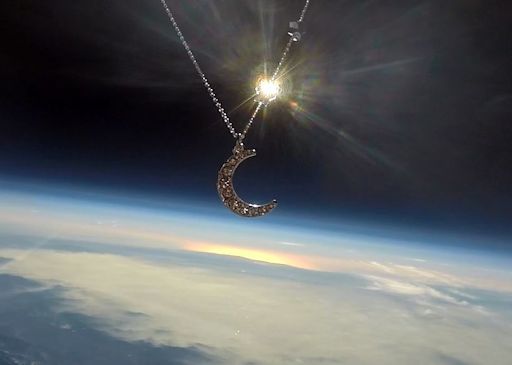
These necklaces make great Mother's Day gifts--and you have have one for $89.95. Each glittering pendant comes with a greeting card showing the jewelry in flight and telling the story of its journey to the stratosphere and back again.
More far-out Mother's Day gifts may be found in the Earth to Sky Store. All proceeds support atmospheric radiation monitoring and hands-on STEM education.
A QUAKE IN EARTH'S MAGNETIC FIELD: When a CME from the sun struck Earth on April 22nd, our planet's magnetic field reverberated from the impact. A day later, a stream of solar wind arrived, hit, and had the same effect. In Lancashire, England, a magnetometer operated by Stuart Green captured the quaking of Earth's magnetic field:

"The data clearly show when the relative calm was shattered on April 21st at around 16:30 (UT) when the CME struck, being quickly followed by fast flowing solar wind from a large and persistent coronal hole," says Green. "The rumblings have been continuing through the intervening days."
Vibrations in the magnetic field allow particles normally trapped in our planet's magnetosphere to rain down around the poles, igniting auroras. Thomas J. Spence was camping in the Boundary Waters Canoe Area of northern Minnesota on April 22nd when the sky suddenly lit up:
