LONG RANGE FORECAST: NOAA forecasters say that G2-class geomagnetic storms are possible on May 19-20 when a solar wind stream is expected to hit Earth's magnetic field. This is the same stream that hit Earth on April 24-25, sparking bright auroras around both poles. In May, it will return for another lashing as the sun's rotation turns the underlying coronal hole back toward our planet. Free: Aurora Alerts


CRESCENT SUPERMOON: If you thought last night's crescent Moon was super-beautiful, you were right. It was a crescent supermoon. Peter Lowenstein photographed the slender arc from Mutare, Zimbabwe:

"The evening sky was perfectly clear and allowed a good view of the very young crescent supermoon," says Lowenstein. "At first the thin crescent was difficult to locate above the sunset glare (first picture) but as the orange light faded and the sky turned turned lilac and then blue it became clearly visible to the north of Christmas Pass."
What made the crescent "super"? Anyone reading NASA press releases in recent years has heard of "supermoons"--full Moons that are extra big and bright because they occur on the perigee side of the Moon's elliptical orbit. Last night's sky show was the same phenomenon, writ slender. The crescent Moon of April 27th occurred at perigee, making it as much as 14% wider and 30% brighter than other crescent Moons of the year.

Realtime Space Weather Photo Gallery
THESE PENDANTS HAVE TOUCHED SPACE: These pendants have touched space--and returned to Earth in time for Mother's Day. To support their cosmic ray monitoring program, the students of Earth to Sky Calculus flew a payload-full of jewelry to the stratosphere onboard a high-altitude helium balloon. Here's one of the pendants 113,200 feet above the Sierras of central California:
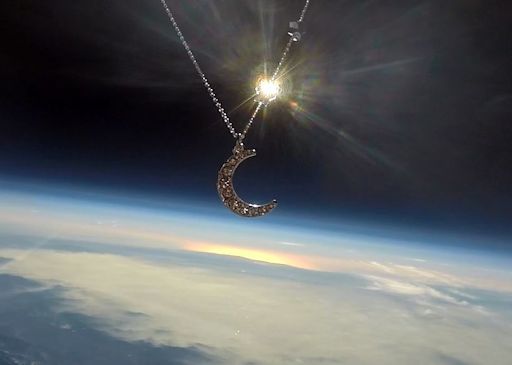
These necklaces make great Mother's Day gifts--and you have have one for $89.95. Each glittering pendant comes with a greeting card showing the jewelry in flight and telling the story of its journey to the stratosphere and back again.
More far-out Mother's Day gifts may be found in the Earth to Sky Store. All proceeds support atmospheric radiation monitoring and hands-on STEM education.