MAGNETIC STORM POSSIBLE THIS WEEK: A filament of magnetism on the sun exploded yesterday (April 30th), hurling a CME into space. NOAA analysts say the cloud could deliver a glancing blow to Earth's magnetic field on May 3rd with a 40% chance of ensuing minor geomagnetic storms. High-latitude sky watchers should be alert for auroras, especially in the southern hemisphere where darkening autumn skies favor visibility. Free: Aurora Alerts
METEORS FROM HALLEY'S COMET: According to Canada's Meteor Orbit Radar (CMOR), a "hot spot" has appeared in the constellation Aquarius. This is a sign that the annual eta Aquarid meteor shower (ETA) is underway. This sky map shows where the radar is detecting pings from incoming meteors in broad daylight on May 1st:

These meteors are pieces of Halley's Comet, hitting Earth's atmosphere at 66 km/s and disintegrating ~100 km above Earth's surface. During the next week our planet will be crossing a network of debris streams from the comet, producing a drizzle of eta Aquarids numbering 10 to 30 per hour in the northern hemisphere and twice that number in the southern hemisphere.
Two leading meteor forecasters have noted the possibility of eta Aquarid outbursts in the days ahead. Mikhail Maslov says meteor activity could increase on May 4th (14h- 18h UT) when Earth grazes a dust trail released by Comet Halley in the year -616. Forecaster Mikiya Sato agrees that that Earth could encounter the -616 dust trail, but later on May 5th (05h - 15h UT), possibly with such a gentle graze that no special increase is detectable. In most years the strongest activity is seen around May 6th, which may still prove true in 2017.
The best time to look, no matter where you live, is during the dark hours just before dawn when the constellation Aquarius is rising in the east. Monitor the meteor gallery for sightings.
Realtime Space Weather Photo Gallery
THESE PENDANTS HAVE TOUCHED SPACE: These pendants have touched space--and returned to Earth in time for Mother's Day. To support their cosmic ray monitoring program, the students of Earth to Sky Calculus flew a payload-full of jewelry to the stratosphere onboard a high-altitude helium balloon. Here's one of the pendants 113,200 feet above the Sierras of central California:
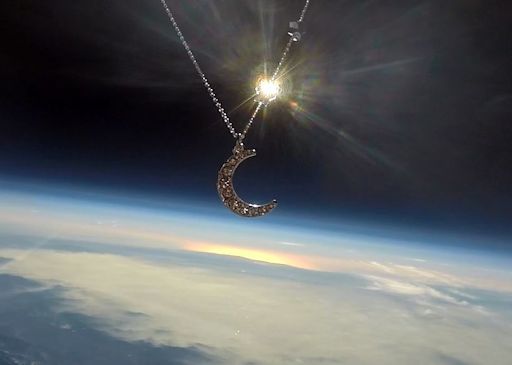
These necklaces make great Mother's Day gifts--and you have have one for $89.95. Each glittering pendant comes with a greeting card showing the jewelry in flight and telling the story of its journey to the stratosphere and back again.
More far-out Mother's Day gifts may be found in the Earth to Sky Store. All proceeds support atmospheric radiation monitoring and hands-on STEM education.
Realtime Space Weather Photo Gallery
RARE BLUE AURORAS: Northern Lights are usually green, and sometimes red. Those are the colors produced by oxygen when it is excited by electrons raining down from space. On April 22nd, Didier Lindsey of Fox, Alaska, witnessed an apparition of aurora-blue:

Hours before he took the picture, a CME struck Earth's magnetic field, igniting a G2-class geomagnetic storm. "The sky filled with very active auroras," Lindsey says,"including these rare blues."

In auroras, blue is a sign of nitrogen. Energetic particles striking ionized molecular nitrogen (N2+) at very high altitudes produces a cold azure glow of the type captured in Lindsey's photo. Why it rivaled the usual hues of oxygen on April 22nd is unknown. Auroras still have the capacity to surprise.
Any auroras tonight, blue or otherwise, would be a surprise. Geomagnetic conditions are quiet as the solar wind relaxes into a steady breeze of low-speed plasma. NOAA forecasters estimate a scant 10% chance of polar geomagnetic storms on April 29th.