WEAK IMPACT: Arriving later than expected, the flank of a CME that left the sun on April 30th grazed Earth's magnetic field during the waning hours of May the 4th. The impact was weak and, regrettably, did not spark a Star Wars Day geomagnetic storm. Faint auroras are possible at high latitudes as Earth moves through the CME's magnetized wake on May 5th. Free: Aurora Alerts
BLUE MOON OVER BEIJING: "Once in a blue moon" is supposed to mean "seldom" or "absurd." Yesterday in Beijing it meant that a dust storm was in progress. On May the 4th, massive clouds of desert dust from Mongolia swept through the city, choking residents and changing the appearance of the sky. A Spaceweather.com reader in the metropolis watched the waxing gibbous moon turn blue:

Blue moons are not as rare as folklore would have us believe. They usually appear after volcanic eruptions or major forest fires fill the air with ash and dust. If the airborne particles are just the right size--about 1 micron (one millionth of a meter) wide--they act like a color-filter, tinging the moon blue. Clouds of fine-grained Mongolian sand can do the same thing.
Realtime Space Weather Photo Gallery
MOTHER'S DAY AT THE EDGE OF SPACE: These pendants have touched space--and returned to Earth in time for Mother's Day. On April 15, 2017, the students of Earth to Sky Calculus flew a payload-full of heart-shaped Venus pendants to the stratosphere onboard a high-altitude helium balloon. Here's one, 111,550 feet above the Sierras of central California:
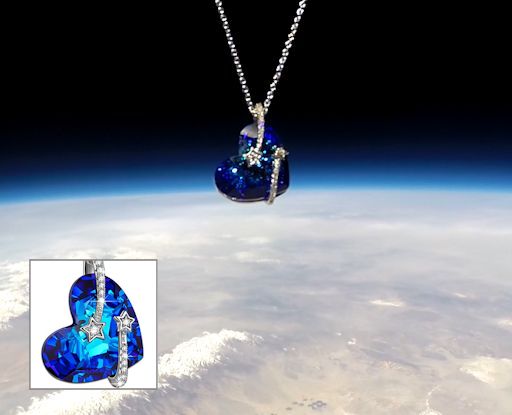
These blue jewels make great Mother's Day gifts--and you have have one for $129.95. Each glittering pendant comes with a greeting card showing the jewelry in flight and telling the story of its journey to the stratosphere and back again.
More far-out Mother's Day gifts may be found in the Earth to Sky Store. All proceeds support atmospheric radiation monitoring and hands-on STEM education.
METEORS FROM HALLEY'S COMET: This week Earth is passing through a broad stream of debris from Halley's Comet, source of the annual eta Aquarid meteor shower. Specks of ancient dust from the comet are disintegrating in Earth's atmosphere producing a drizzle of shooting stars. Eliot Herman photographed this one streaking over Tucson, Arizona, before sunrise on May 3rd:
"With clear skies this week, the hunt for eta Aquarids is on," says Herman. "This photo is from an all night series of fisheye images taken with a Nikon D810 at 15 sec each, ISO 3200."
Forecasters expect the shower to peak on May 5th and 6th with 10 to 30 meteors per hour visible from the northern hemisphere, and twice that number from the southern hemisphere. No matter where you live, the best time to look is during the dark hours before local sunrise when the constellation Aquarius is rising in the east.