CME IMPACT POSSIBLE ON MAY 10TH: On May the 4th, unstable magnetic fields in the sun's atmosphere shifted and hurled a CME into space. The cloud's velocity was relatively low; indeed, it appears that it will take 6 whole days to cross the sun-Earth divide. NOAA forecasters expect it to arrive on May 10th. Polar geomagnetic activity is therefore possible next week. Free: Aurora Alerts
"RADIO-ACTIVE" METEOR SHOWER: This weekend's eta Aquarid meteor shower, caused by debris from Halley's Comet, is causing strong radar echoes over Europe. On May 6th, "we had very dense fog in Radebeul, Germany, so no visual observations of the Eta Aquarids were possible," report amateur astronomers Thomas Böhme, Heiko Ulbricht, and Mario Ludwig. "So we listened to their radar echoes instead."

As the meteors passed over Europe, they were illuminated by signals from France's GRAVE space surveillance radar, used by the French government to track Earth-orbiting satellites. The meteors added an extra set of echoes not normally present. Using a Yagi antenna and a radio receiver tuned to 143 MHz (the operating frequency of the radar), the astronomers in Germany listened to the activity.
"We detected very powerful echoes, very much stronger after midnight," says Böhme. "The Doppler effect (caused by the rapid motion of the meteors) was very good to hear." They also detected radar reflections from the Moon. "Coincidentally, the Moon was within the beam of our antenna and we could receive 'moon-bounce' echoes as well."
Meanwhile in Puerto Rico, amateur astronomer Frankie Lucena experienced the shower the old-fashioned way--by looking. "I was facing south from Cabo Rojo at 4:56am on May 5th when I saw this meteor," says Lucena. "It was a beauty."

The display should continue on May 6th and possibly the 7th as Earth continues its passage through a broad stream of debris from Halley's Comet. Forecasters expect 10 to 30 meteors per hour in the northern hemisphere, and perhaps twice that many in the southern hemisphere. The best time to look, no matter where you live, is during the dark hours before local sunrise.
MOTHER'S DAY AT THE EDGE OF SPACE: These pendants have touched space--and returned to Earth in time for Mother's Day. On April 15, 2017, the students of Earth to Sky Calculus flew a payload-full of heart-shaped Venus pendants to the stratosphere onboard a high-altitude helium balloon. Here's one, 111,550 feet above the Sierras of central California:
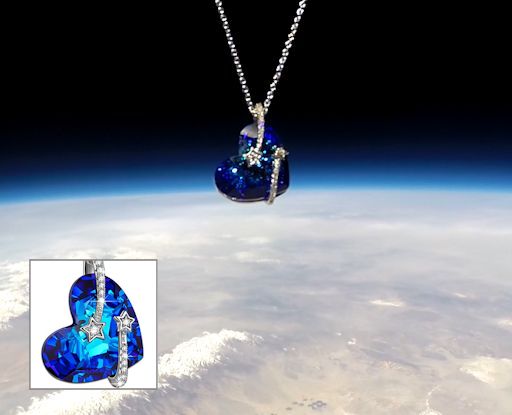
These blue jewels make great Mother's Day gifts--and you have have one for $129.95. Each glittering pendant comes with a greeting card showing the jewelry in flight and telling the story of its journey to the stratosphere and back again.
More far-out Mother's Day gifts may be found in the Earth to Sky Store. All proceeds support atmospheric radiation monitoring and hands-on STEM education.
BLUE MOON OVER BEIJING: "Once in a blue moon" is supposed to mean "seldom" or "absurd." On May the 4th in Beijing, China, it meant that a dust storm was in progress. With little warning, massive clouds of desert dust from Mongolia swept through the city, choking residents and changing the appearance of the sky. A Spaceweather.com reader in the metropolis watched the waxing gibbous moon turn blue:

Blue moons are not as rare as folklore would have us believe. They usually appear after volcanic eruptions or major forest fires fill the air with ash and dust. If the airborne particles are just the right size--about 1 micron (one millionth of a meter) wide--they act like a color-filter, tinging the moon blue. Clouds of fine-grained Mongolian sand can do the same thing.
Realtime Space Weather Photo Gallery