CME IMPACT POSSIBLE THIS WEEK: On May the 4th (Star Wars Day), unstable magnetic fields in the sun's atmosphere shifted and hurled a CME into space. The cloud's velocity was relatively low, and it might take 6 whole days to cross the sun-Earth divide. NOAA forecasters expect the "Star Wars Day CME" to arrive on May 10th, possibly causing geomagnetic activity around the poles. Free: Aurora Alerts
JUPITER AND THE MOON: When the sun goes down tonight, step outside and look southeast. You'll see the waxing Flower Moon slowly retreating from a close encounter with Jupiter. Last night in Radebeul, Germany, Heiko Ulbricht photographed the celestial bodies only 1.3o apart:

"It was a beautiful conjunction," says Ulbricht. "The Moon and Jupiter were so bright, the clouds came in handy as a dimming filter for my 1.3s exposure."
They are still relatively close together on May 8th. If you go out to see them, try to catch the pair before the sky fades completely black. The sight of Jupiter and the Moon framed by twilight blue is beautiful indeed. [sky map]

Realtime Space Weather Photo Gallery
THE SUN IS BOILING: The disk of the sun may look serene as it shines high in the noontime sky--but don't be fooled. Our star is in a constant state of writhing motion. To illustrate this truth, on April 29th amateur astronomer Pascal Paquereau of Vendée, France, video-recorded a patch of solar terrain around quiet sunspot AR2653. Click to set the scene in motion:

"I used a 10-inch SkyWatcher telescope capped with an Astrosolar Baader filter to capture this 15 minute animation," explains Paquereau. "The seeing was quite good."
His high-resolution images show something that astronomers have long known: The sun is so hot, it literally boils. Bumps on the boiling surface of the sun are called "granules." You can find granules in your kitchen, too, in a pot of hot water boiling on the stove. One difference: While the granules on your stove are only a few centimeters across, granules on the sun are as wide as Texas.

Got it? Now you're ready for the Solar Granulation Quiz.
Realtime Space Weather Photo Gallery
MOTHER'S DAY AT THE EDGE OF SPACE: These pendants have touched space--and returned to Earth in time for Mother's Day. On April 15, 2017, the students of Earth to Sky Calculus flew a payload-full of heart-shaped Venus pendants to the stratosphere onboard a high-altitude helium balloon. Here's one, 111,550 feet above the Sierras of central California:
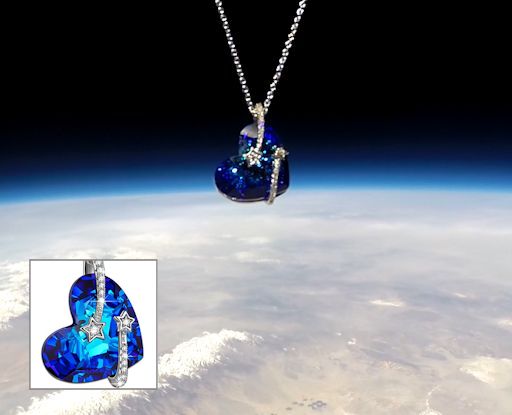
These blue jewels make great Mother's Day gifts--and you have have one for $129.95. Each glittering pendant comes with a greeting card showing the jewelry in flight and telling the story of its journey to the stratosphere and back again.
More far-out Mother's Day gifts may be found in the Earth to Sky Store. All proceeds support atmospheric radiation monitoring and hands-on STEM education.