STEALTH CME IMPACT: A slow-moving "stealth CME" swept past Earth on May 10th. The impact was so gentle, it was almost unnoticed. However, there was a periodic disturbance in the solar wind near Earth--waves of south-pointing magnetism that slightly disturbed the geomagnetic field. No auroras were observed. Free: Aurora Alerts
THE SUN IS BLANK: For the second day in a row, the sun is blank--no sunspots. NASA's Solar Dynamics Observatory photographed the featureless face of our star on May 11th:

This marks the 32nd day in 2017 that the sun has been without spots. Cumulatively, it adds up to more than a month of blank suns--and it's only May. For comparison, it took all 12 months of 2016 for the sun to accumulate 32 spotless days. The accelerating pace of spotlessness is a sign that Solar Minimum is approaching.
Solar Minimum is yin to the yang of Solar Maximum, a natural part of the sun's 11 year sunspot cycle. Contrary to popular belief, Solar Minimum is not boring ...only different. It brings a time of enhanced cosmic rays, pink auroras, a collapsing ionosphere and accumulating space junk. With action like that, who needs sunspots? Stay tuned for more blank suns.
Realtime Space Weather Photo Gallery
SPACESHIP TRANSITS THE FLOWER MOON: According to folklore, this week's full Moon is the Flower Moon. Northern spring flowers are abundant in May, and the Moon illuminates them beautifully after sunset. Last night in Aguadilla, Puerto Rico, amateur astronomer Efrain Morales Rivera was photographing the bright orb when a winged spaceship flitted overhead:

"It was the International Space Station (ISS)," explains Rivera, "crossing the rays of the Crater Tycho."
Backlit by the Moon, the outlines of the ISS are clearly visible. The wings are solar arrays, containing a total of 262,400 solar cells. Altogether, the four sets of arrays can generate 84 to 120 kilowatts of electricity -- enough to provide power to more than 40 homes.
Some of that electricity is being used to grow ... you guessed it ... flowers. The first petals of orange zinnias opened in early 2016, and the flowers are now regular participants in space gardening research. This week's Moon is the Flower Moon on the ISS, too.
Realtime Space Weather Photo Gallery
MOTHER'S DAY AT THE EDGE OF SPACE: These pendants have touched space--and returned to Earth in time for Mother's Day. On April 15, 2017, the students of Earth to Sky Calculus flew a payload-full of heart-shaped Venus pendants to the stratosphere onboard a high-altitude helium balloon. Here's one, 111,550 feet above the Sierras of central California:
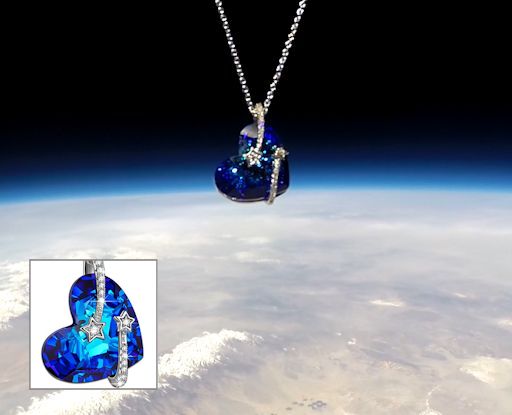
These blue jewels make great Mother's Day gifts--and you have have one for $129.95. Each glittering pendant comes with a greeting card showing the jewelry in flight and telling the story of its journey to the stratosphere and back again.
More far-out Mother's Day gifts may be found in the Earth to Sky Store. All proceeds support atmospheric radiation monitoring and hands-on STEM education.