BE ALERT FOR NOCTILUCENT CLOUDS: The northern season for noctilucent clouds (NLCs) is about to begin. Glowing electric blue at the edge of space, the icy clouds appear over the Arctic in late May and last until August. Usually, NASA's AIM spacecraft is the first to spot them--but maybe not this year. Cora Randall, a member of the AIM science team at the University of Colorado, explains: "Currently, we are not retrieving cloud data. Because the orbit of the spacecraft has precessed, we are transitioning to a new way of pointing. We need a bit more time to settle the spacecraft pointing and hope to be back online by the end of May." Meanwhile, high-latitude sky watchers should be alert for NLCs; the season might begin before AIM is ready. [NLC photo gallery]
CHANCE OF STORMS THIS WEEK (UPDATED): NOAA forecasters say there is a 40% chance of geomagnetic storms this week, beginning with G1-class storms on May 16th, escalating to G2-class on May 17th. The reasons are twofold. First, Earth will be hit by a stream of solar wind flowing from a hole in the sun's atmosphere:


Image credit: NASA Solar Dynamics Observatory/LMSAL/Spaceweather.com
This is a coronal hole (CH)--a place where the sun's magnetic field peels back and allows solar wind to escape. Gaseous material streaming from the gap should arrive on May 16th, sparking G1-class storms.
Second, a coronal mass ejection (CME) is following on the heels of the solar wind stream. The faint CME left the sun on May 13th, heading slightly south of the sun-Earth line. NOAA computer models suggest that the cloud will graze Earth's magnetic field on May 17th. The combined action of the solar wind stream and the CME could boost storm levels from G1 to G2.

High-latitude sky watchers should be alert for auroras, especially in the southern hemisphere where deepening autumn darkness favors visibility. Free: Aurora Alerts
COSMIC RAYS ARE INTENSIFYING: As the sunspot cycle declines, we expect cosmic rays to increase. Is this actually happening? The answer is "yes." Spaceweather.com and the students of Earth to Sky Calculus have been monitoring radiation levels in the stratosphere with frequent high-altitude balloon flights over California. Here are the latest results, current as of May 6, 2017:
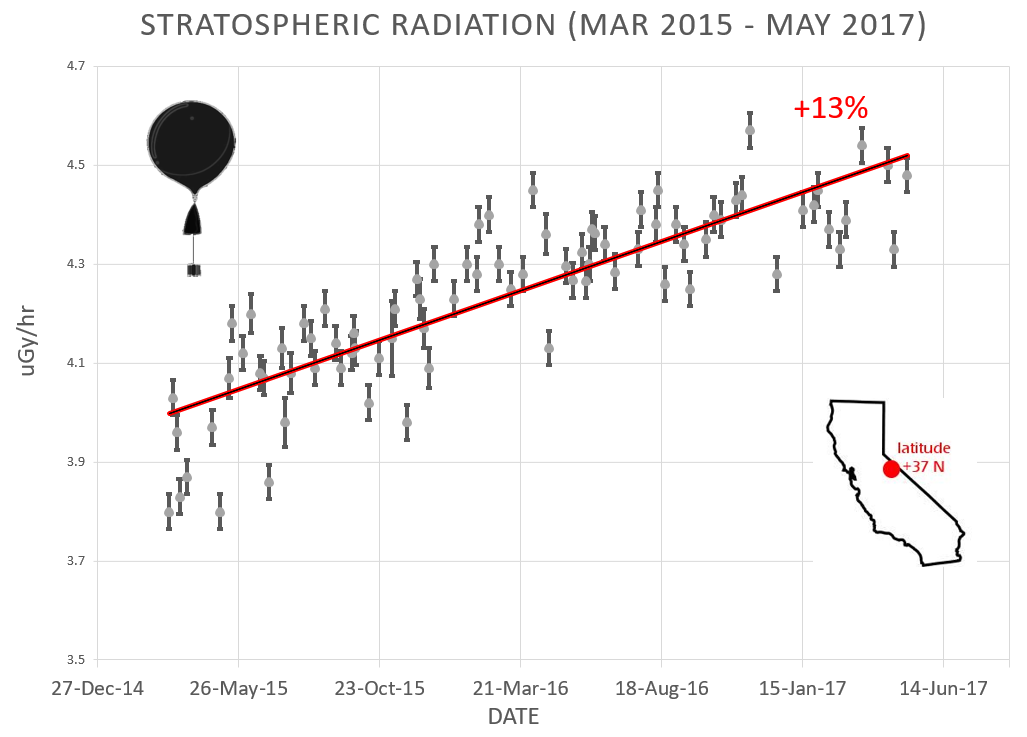
The data show cosmic ray levels intensifying with an approximately 13% increase since March 2015.
Cosmic rays are high-energy photons and subatomic particles accelerated in our direction by distant supernovas and other violent events in the Milky Way. Usually, cosmic rays are held at bay by the sun's magnetic field, which envelops and protects all the planets in the Solar System. But the sun's magnetic shield is weakening in 2017 as the solar cycle shifts from Solar Maximum to Solar Minimum. More and more cosmic rays are therefore reaching our planet.
How does this affect us? Cosmic rays penetrate commercial airlines, dosing passengers and flight crews enough that pilots are classified as occupational radiation workers. Some research shows that cosmic rays can seed clouds and trigger lightning, potentially altering weather and climate. Furthermore, there are studies ( #1, #2, #3, #4) linking cosmic rays with cardiac arrhythmias in the general population.
The sensors we send to the stratosphere measure X-rays and gamma-rays, which are produced by the crash of primary cosmic rays into Earth's atmosphere. The energy range of the sensors, 10 keV to 20 MeV, is similar to that of medical X-ray machines and airport security scanners.
NOTE: This increase is not happening ONLY over California. All parts of the world will be experiencing elevated levels of cosmic rays. The amount varies from place to place depending on the uneven protection afforded by our own planet's magnetic field. In the days ahead we will share new data from intercontinental balloon launches tracing the global response to this phenomenon.
Realtime Space Weather Photo Gallery
THIS PENDANT HAS TOUCHED SPACE: The radiation monitoring program of Earth to Sky Calculus receives no support from corporate sponsors or government grants. Instead, we are crowd-funded. Or, to be more precise, bling- funded:

To raise money for more cosmic ray balloon flights, on May 6th the students launched a payload of these Northern Lights pendants to the top of Earth's atmosphere. You can have one for $79.95. Each piece of space jewelry comes with a greeting card showing the item in flight and telling the story of its journey to the stratosphere and back. They make great birthday and Mother's Day gifts.
More far-out gifts may be found in the Earth to Sky Store. All proceeds support atmospheric radiation monitoring and hands-on STEM education.