GEOMAGNETIC STORM WATCH: NOAA forecasters say G2-class geomagnetic storms are possible on May 17th when a CME is expected to deliver a glancing blow to Earth's magnetic field. High-latitude sky watchers should be alert for auroras, especially in the southern hemisphere where deepening autumn darkness favors visibility. Free: Aurora Alerts

POTENT CORONAL HOLE: Another coronal hole (CH) is turning toward Earth, and it is a potent one. NASA's Solar Dynamics Observatory photographed the structure on May 16th:

Image credit: NASA Solar Dynamics Observatory/LMSAL/Spaceweather.com
Coronal holes are places where the sun's magnetic field peels back and allows the solar wind to escape. Gaseous material flowing from this hole is moving very fast, more than 700 km/s. Moreover, the wind is threaded with "negative polarity" magnetic fields--and that's what makes it potent. Such fields do a good job connecting to Earth's magnetosphere and energizing geomagnetic storms.
The solar wind stream should reach Earth later this week, adding its effect to that of the CME due on May 17th. Stay tuned. Free: Aurora Alerts
POLLEN CORONA: It begins with a sneeze. Pollen floating through the air tickles your nose, and your body responds by expelling the allergen. Gesundheit! When the paroxysm subsides, look up at the sky. The same pollen that makes you sneeze can also make beautiful coronas around the sun, like this one photographed on May 15th by John Stetson of Sebago Lake, Maine:

"When white pine pollen is in the air, we often see diffraction rings around our sun here in Maine," says Stetson. "My wife, Katy, kindly blocked the sun for this picture of the surrounding halo."
Atmospheric optics expert Les Cowley explains the phenomenon: "Coronas are produced when light waves scatter from the outsides of small particles. Tiny droplets of water in clouds make most coronas, but opaque pollen grains do even better. They make small but very colorful multi-ringed coronas."
As northern spring turns into summer, pollen coronas become increasingly common. Look for them the next time your nose feels a tickle.
Realtime Space Weather Photo Gallery
THIS PENDANT HAS TOUCHED SPACE: The radiation monitoring program of Earth to Sky Calculus receives no support from corporate sponsors or government grants. Instead, we are crowd-funded. Or, to be more precise, bling- funded:
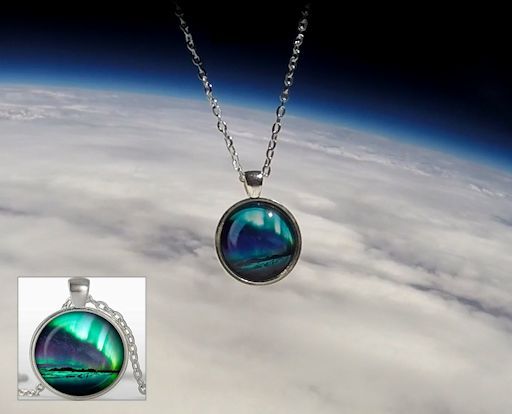
To raise money for more cosmic ray balloon flights, on May 6th the students launched a payload of these Northern Lights pendants to the top of Earth's atmosphere. You can have one for $79.95. Each piece of space jewelry comes with a greeting card showing the item in flight and telling the story of its journey to the stratosphere and back. They make great birthday and Mother's Day gifts.
More far-out gifts may be found in the Earth to Sky Store. All proceeds support atmospheric radiation monitoring and hands-on STEM education.