SLIGHT CHANCE OF STORMS: NOAA forecasters say there is a 20% chance of polar geomagnetic storms on May 23rd as Earth exits a fast-moving stream of solar wind. Sky watchers at Canadian latitudes might see auroras, especially during the hours around local midnight. Free: Aurora Alerts
SPRITE SEASON BEGINS: High above Earth in the realm of meteors and noctilucent clouds, a strange and beautiful form of lightning dances at the edge of space. Researchers call the bolts "sprites"; they are red, fleeting, and tend to come in bunches. Note to sky watchers: Sprite season is underway. On May 19th, Laura Kranich photographed these specimens over Ziethen, Brandenburg, Germany:
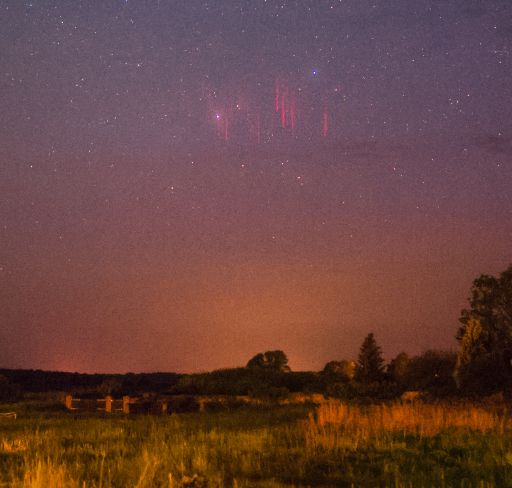
"The sprites appeared over a mesoscale convective system that moved through northern Germany," says Kranich. "I drove to eastern Germany to find a clear sky and to get a more distant view of the storm. (Distance can help see over the cloudtops.)"
Because sprites are associated with thunderstorms, they tend to occur in late spring and summer. Thunderstorm season is sprite season.

"Sprites are a true space weather phenomenon," explains lightning scientist Oscar van der Velde of the Technical University of Catalonia, Spain. "They develop in mid-air around 80 km altitude, growing in both directions, first down, then up. This happens when a fierce lightning bolt draws lots of charge from a cloud near Earth's surface. Electric fields [shoot] to the top of Earth's atmosphere--and the result is a sprite. The entire process takes about 20 milliseconds."
Although sprites have been seen for at least a century, most scientists did not believe they existed until after 1989 when sprites were photographed by cameras onboard the space shuttle. Now "sprite chasers" routinely photograph sprites from their own homes. Give it a try!
Realtime Space Weather Photo Gallery
STEVE, IN MOTION: On May 19th and 20th, a solar wind stream hit Earth's magnetic field. The impact summoned "Steve"--a mysterious form of filamentary aurora that researchers do not fully understand. "I saw 'Steve' through the window even though the lights were still on in the house, so it must have been quite bright," reports Matthew Wheeler of Robson Valley, BC, Canada. Grabbing his camera, he rushed outside for a better view, and captured a rare movie of Steve in motion:

"I have seen Steve here a few times in the past decades," says Wheeler. "This was a dramatic apparition, especially overhead where fine fingers of color moved very fast almost at right angles to Steve, quite finely detailed at times. The 10 second exposures I stitched together to make the animation don't do it justice."
Realtime "Steve" Photo Gallery
THIS PENDANT HAS TOUCHED SPACE: The radiation monitoring program of Earth to Sky Calculus receives no support from corporate sponsors or government grants. Instead, we are crowd-funded. Or, to be more precise, bling-funded:
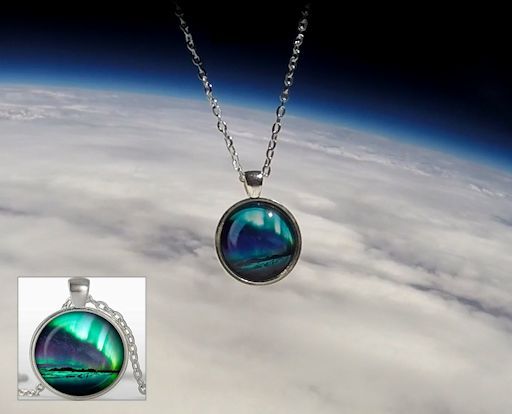
To raise money for more cosmic ray balloon flights, on May 6th the students launched a payload of these Northern Lights pendants to the top of Earth's atmosphere. You can have one for $79.95. Each piece of space jewelry comes with a greeting card showing the item in flight and telling the story of its journey to the stratosphere and back. They make great birthday and belated Mother's Day gifts.
More far-out gifts may be found in the Earth to Sky Store. All proceeds support atmospheric radiation monitoring and hands-on STEM education.
Realtime Space Weather Photo Gallery