WAITING FOR THE CME: A coronal mass ejection (CME) that left the sun on May 23rd could deliver a glancing blow to Earth's magnetic field later today. So far, however, there is no sign of the lopsided cloud. A miss is just as likely as a hit. Stay tuned. Free: Aurora Alerts

DAYTIME CONJUNCTION: Venus is so bright, you can see it in broad daylight. Most observers, however, fail to notice it. The intense pinprick of white light can be hard to locate in a sea of bright blue. What you need is a guide ... or an airplane! On May 26th, Leo Caldas of Brasilia, Brasil, noticed Venus when a Boeing 777 flew past the 2nd planet:

"United flight 149 from New York to São Paulo flew over Brasilia--and right by Venus," says Caldas. "As this map shows, I was perfectly positioned to witness the plane-planet conjunction."

Venus is so bright because it is shrouded in a global blanket of acid clouds. They reflect more than 75% of the sunlight that falls on them. For comparison, the average reflectivity of Earth is only about 30% and the Moon 12%. Venus's reflectivity and proximity to the sun combine to make it shine in the skies of Earth 100 times brighter than a 1st magnitude star.
Realtime Space Weather Photo Gallery
THE UNUSUAL ORBIT OF SPY SATELLITE USA 276: On May 1st, SpaceX launched a classified satellite from Cape Canaveral: USA 276. "Last night, it passed over my house glowing like a 3rd magnitude star," reports veteran satellite observer Marco Langbroek, who sends this picture from Leiden, the Netherlands:
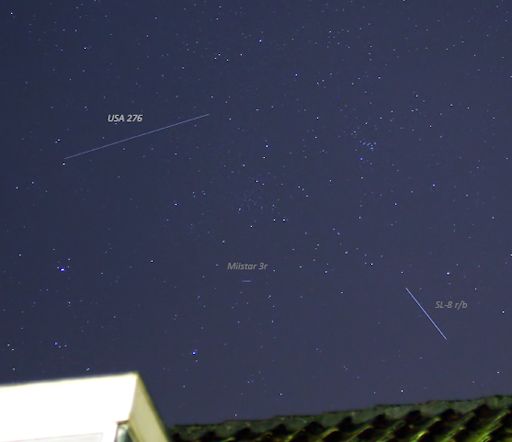
"The mystery payload appeared alongside a number of other objects (including the classified Milstar 3 r/b)," he says. "It's getting crowded up there."
Immediately after its May 1st launch, USA 276 was a topic of much discussion among expert observers. "The launch azimuth seemed to suggest a 50 degree orbital inclination," says Langbroek. "That would be odd, so not everybody was willing to believe this." But now it is clear that USA 276 does have such an orbit.
As Langbroek explains in his blog, other military and reconnaissance satellites tend to have orbital inclinations clustered around 57 degrees, 123 degrees, 63.4 degrees or 98 degrees.
"An orbital inclination of 50.0 degrees, as shown by USA 276, is odd and unusual. The orbit of USA 276 is remarkably similar to that of the ISS, in fact, as shown by Ted Molczan in a private communication. The two can potentially even make quite close approaches, to within a few km."
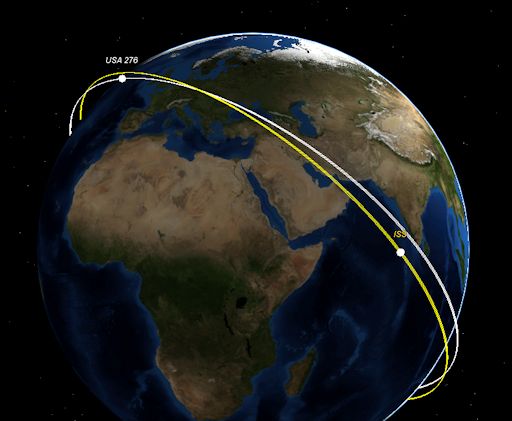
Indeed, a close encounter could be in the offing. "I have found that on June 4, USA 276 will in fact be very close by when the SpaceX DRAGON CRS-11 supply ship is scheduled to arrive at the ISS--that is, if USA 276 doesn't change its current orbit before then. Observers in Europe might see the three objects close together in their evening twilight of June 3, with USA 276 some 15 degrees distant from the ISS."
No one knows if this is plan or pure coincidence ... or if the conjunction will even happen. One thing is sure: Observers in Europe will be watching. Stay tuned for updates.
Realtime Space Weather Photo Gallery
THIS PENDANT HAS TOUCHED SPACE: The radiation monitoring program of Earth to Sky Calculus receives no support from corporate sponsors or government grants. Instead, we are crowd-funded. Or, to be more precise, bling-funded:

To raise money for more cosmic ray balloon flights, on May 6th the students launched a payload of these Northern Lights pendants to the top of Earth's atmosphere. You can have one for $79.95. Each piece of space jewelry comes with a greeting card showing the item in flight and telling the story of its journey to the stratosphere and back. They make great birthday and belated Mother's Day gifts.
More far-out gifts may be found in the Earth to Sky Store. All proceeds support atmospheric radiation monitoring and hands-on STEM education.