THE CME HAS ARRIVED: Arriving almost 24 hours later than expected, a CME sideswiped Earth's magnetic field on May 27th at approximately 1500 UT. So far the relatively weak impact has not caused any notable geomagnetic activity. Nevertheless, high-latitude sky watchers should be alert for auroras as Earth passes through the CME's magnetized wake. Free: Aurora Alerts
THE 1% LUNAR CRESCENT: Chris Schur of Payson, Arizona, has been planning this shot for months. "The opportunity came Friday morning, with the rising sun halfway up the sky," he says. "I pointed my telescope 15 degrees east of the sun and there it was!" Behold, the 1% crescent Moon:

"This is by far the thinnest crescent moon I have ever imaged," says Schur. "Here the moon is .80 days old - 19.2 hours according to the Virtual Moon Atlas. The illumination is 1.0%."
"And yes - I did view the crescent visually," he says. "It was really tough! I could see only a portion of the crescent at one time in a low power ocular, but it was there against a light blue sky."
Readers, you can see a slender crescent Moon tonight with considerably less effort. When the sun goes down, step outside and face west. A 3% crescent Moon will emerge at the feet of Castor and Pollux, the twins of Gemini. Enjoy the show! [sky map]

Realtime Space Weather Photo Gallery
DAYTIME CONJUNCTION: Venus is so bright, you can see it in broad daylight. Most observers, however, fail to notice it. The intense pinprick of white light can be hard to locate in a sea of bright blue. What you need is a guide ... or an airplane! On May 26th, Leo Caldas of Brasilia, Brasil, noticed Venus when a Boeing 777 flew past the 2nd planet:

"United flight 149 from New York to São Paulo flew over Brasilia--and right by Venus," says Caldas. "As this map shows, I was perfectly positioned to witness the plane-planet conjunction."

Venus is so bright because it is shrouded in a global blanket of acid clouds. They reflect more than 75% of the sunlight that falls on them. For comparison, the average reflectivity of Earth is only about 30% and the Moon 12%. Venus's reflectivity and proximity to the sun combine to make it shine in the skies of Earth 100 times brighter than a 1st magnitude star.
Realtime Space Weather Photo Gallery
THIS PENDANT HAS TOUCHED SPACE: The radiation monitoring program of Earth to Sky Calculus receives no support from corporate sponsors or government grants. Instead, we are crowd-funded. Or, to be more precise, bling-funded:
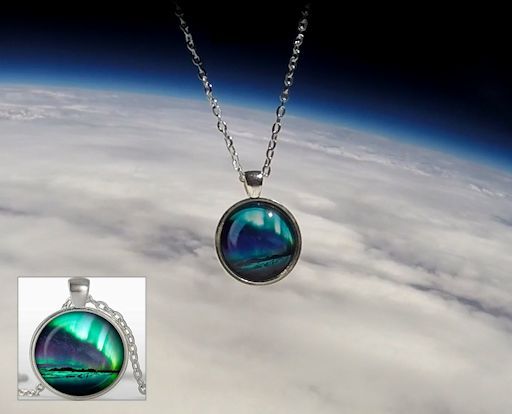
To raise money for more cosmic ray balloon flights, on May 6th the students launched a payload of these Northern Lights pendants to the top of Earth's atmosphere. You can have one for $79.95. Each piece of space jewelry comes with a greeting card showing the item in flight and telling the story of its journey to the stratosphere and back. They make great birthday and belated Mother's Day gifts.
More far-out gifts may be found in the Earth to Sky Store. All proceeds support atmospheric radiation monitoring and hands-on STEM education.