CME HITS, SPARKS AURORAS (UPDATED): A CME hit Earth's magnetic field on May 27th. At first, for several hours, the seemingly weak impact barely disturbed our planet's magnetic environment. Then the storms began. As Earth passed through the CME's wake, energetic particles poured through a crack in Earth's magnetosphere, sparking strong G3-class geomagnetic storms and bright auroras. Chris Cook recorded the display from Cape Cod, Massachusetts:


"Tonight's surprise aurora was captured around 11:15pm EDT overlooking the calm waters of Cape Cod Bay," says Cook. "Numerous pillars reached to a height of 25°. It was nice to see the Northern Lights again!"
During the peak of the storm, Northern Lights were photographed in the USA as far south as California and Arizona. "After midnight the sky turned pink and a green ray extended up from the horizon," reports Chris Schur of Payson AZ.
The storms are subsiding now. Earth is exiting the CME's wake, and our planet's magnetic field is quieting. Nevertheless, there is a lingering chance of G1-class storms and high-latitude auroras after nightfall on May 28th. Free: Aurora Alerts

TARDIGRADES AT THE EDGE OF SPACE: On May 27th, Spaceweather.com and the students of Earth to Sky Calculus conducted an experiment in astrobiology, launching a sample of tardigrades to the stratosphere during a geomagnetic storm. Here they are at the apex of the flight 34.6 km (113,500 ft) above the Sierra Nevadas of central California:
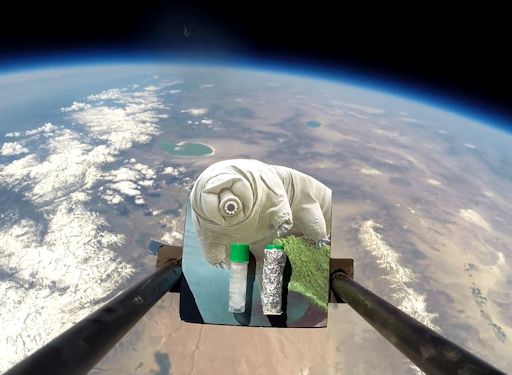
Also known as "water bears," tardigrades are near-microscopic creatures that can survive high doses of ionizing radiation, temperatures almost as low as absolute zero, and pressures six times higher than deep ocean trenches. Can they survive a trip onboard a space weather balloon? That's the question Earth to Sky student Makayla McDevitt is trying to answer for her end-of-term AP Environmental Sciences project.
This photomicrograph shows one of the creatures floating in its watery habitat prior to launch:

The tardigrades traveled to the stratosphere alongside an array of X-ray/gamma-ray sensors that we use to monitor cosmic rays in the atmosphere. Flying these sensors during geomagnetic storms is important because it helps us understand our radiation environment during the full range of space weather conditions. Stay tuned for updates from this flight.
Realtime Space Weather Photo Gallery
THIS PENDANT HAS TOUCHED SPACE: The radiation monitoring program of Earth to Sky Calculus receives no support from corporate sponsors or government grants. Instead, we are crowd-funded. Or, to be more precise, bling-funded:
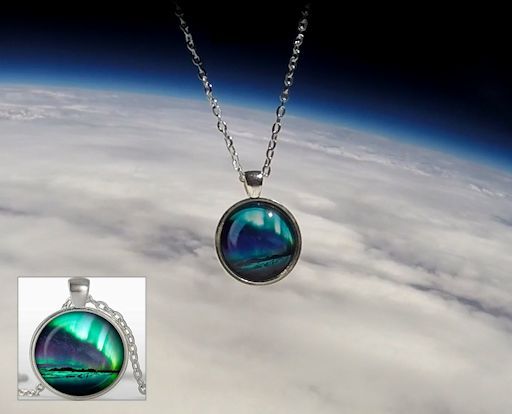
To raise money for more cosmic ray balloon flights, on May 6th the students launched a payload of these Northern Lights pendants to the top of Earth's atmosphere. You can have one for $79.95. Each piece of space jewelry comes with a greeting card showing the item in flight and telling the story of its journey to the stratosphere and back. They make great birthday and belated Mother's Day gifts.
More far-out gifts may be found in the Earth to Sky Store. All proceeds support atmospheric radiation monitoring and hands-on STEM education.