SOLAR EXPLOSION MISSES EARTH: Yesterday, May 30th, a dark filament of magnetism tore through the sun's atmosphere. The explosion hurled a cloud of plasma into space, but the coronal mass ejection (CME) will not hit Earth. It is flying east of the sun-Earth line. NASA's Solar Dynamics Observatory recorded this movie of the blast. Free: Aurora Alerts
NIGHT-GLOWING CLOUDS SIGHTED: Noctilucent cloud (NLC) season is underway. Northern sky watchers are beginning to spot electric-blue tendrils of light creeping over the horizon at sunset. Adrien Mauduit photographed these specimens on May 26th from Ordrup, Sjælland, Denmark:

"They were visible until about 2 in the morning," says Mauduit. Follow-up reports of NLCs have been received from Latvia (May 27th) and Northern Ireland (May 31st).
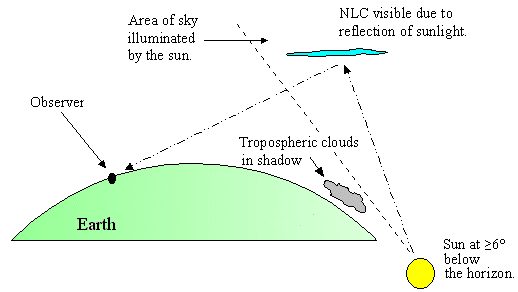
NLCs are Earth's highest clouds. Seeded by meteoroids, they float at the edge of space more than 80 km above the planet's surface. The clouds are very cold and filled with tiny ice crystals. When sunbeams hit those crystals, they glow electric-blue.
Noctilucent clouds are a summertime phenomenon. In the northern hemisphere, they usually appear in late May, then blossom in June and July as ice crystals multiply in the mesosphere high overhead. Here is an example of fully developed NLCs photographed last summer in Sweden:

Photo credit: Ruslan Merzlyakov of Umeå, Sweden. August 7, 2016
Interestingly, NLCs haven't always been here. They first appeared in the 19th century after the eruption of super-volcano Krakatoa. At the time, people thought the clouds were caused by the eruption, but long after Krakatoa's ash settled, the clouds remained. In those days, NLCs were a polar phenomenon confined mainly to the Arctic. In recent years they have intensified and spread with sightings as far south as Utah and Colorado. Some researchers believe the intensification is a sign of climate change.
Observing tips: Look west 30 to 60 minutes after sunset when the sun has dipped 6o to 16o below the horizon. If you see luminous blue-white tendrils spreading across the sky, you may have spotted a noctilucent cloud.
Realtime Noctilucent Cloud Photo Gallery
CALIFORNIA AURORAS: Compared to many other photos of the May 28th geomagnetic storm, which were visually spectacular, this one might not seem noteworthy. Except for one thing: It was taken in California.

"I saw the magnetic storm alert at 11:00pm," says photographer Dan McBride. "When the K-index hit 7, I left my house and drove for 1 1/2 hours to the helipad at Big Hill Lookout, west of Lake Tahoe. I could barely see it, but after my first test shot I knew I had just caught purple pillars from California at latitude 38.8 degrees N."
Auroras in California are rare and remarkable. They are visible to the naked eye typically no more than a few times a decade. The May 28th display was even more remarkable considering the phase of the sunspot cycle: The sun is rapidly plunging toward Solar Minimum. Sunspots are scarce and solar flares are weak at best. Nevertheless, we just experienced a strong geomagnetic storm. The CME that sparked auroras over California this weekend was hurled toward Earth by a seemingly minor magnetic reorganization in the sun's atmosphere.

And so space weather continues--no sunspots required. Free: Aurora Alerts
SPACE BEARS MAKE GOOD GRADUATION GIFTS: Around the USA, high school seniors are preparing to receive their diplomas. Nothing says "you're on your way up!" better than a graduation gift from the Edge of Space. On May 25th, the students of Earth to Sky Calculus flew a family of "graduation grizzlies" 27 km (90,000 feet) above Earth's surface:
Outfitted with space helmets and a diploma, the intrepid Ursidae survived cosmic rays, ultra-low temperatures, and the near-vacuum of the stratosphere. For $49.95 you can have one of these bears along with a unique Graduation card showing the bears floating at the top of Earth's atmosphere. Buy one now.
Sales of the bears support student space weather research. In fact, the bears pictured above were hitchhiking on a payload equipped with radiation sensors. We send the sensors to the stratosphere every week to monitor increasing levels of cosmic rays. Visit the Earth to Sky store to support this crowd-funded research.
Far Out Gifts: Earth to Sky Store
All proceeds support hands-on STEM education.