SLIGHT CHANCE OF STORMS: A solar wind stream flowing from a small hole in the sun's atmosphere will hit Earth's magnetic field on June 2nd or 3rd. NOAA forecasters say there is a 15% chance of polar geomagnetic storms when the solar wind arrives. Free: Aurora Alerts
ACTIVE SUNSPOT: A new sunspot is emerging over the sun's eastern limb, and it is crackling with C-class solar flares. NASA's Solar Dynamics Observatory caught the active region hurling a plume and ball of plasma high above the sun's surface during the early hours of June 1st:

Numbered AR2661, this new sunspot is still rotating into view, so its full size and potential for stronger flares are not yet known. Stay tuned for updates as AR2661 turns toward Earth. Free: Solar Flare Alerts
Realtime Space Weather Photo Gallery
A QUAKE IN EARTH'S MAGNETIC FIELD: A solar coronal mass ejection (CME) struck Earth on May 27th. In Lancashire, England, a magnetometer operated by Stuart Green captured the subsequent quaking of Earth's magnetic field:

"The CME strike over the weekend left Earth's magnetic field ringing like a bell for around 12 hours, as my magnetometer data show," says Green. "It's always exciting to record such events as it is a tangible reinforcement of the real physical connection between our planet and the powerhouse that sustains life on Earth."
When forecasters say "a geomagnetic storm is in progress," the quaking Green recorded is what they mean. Vibrations in the magnetic field can induce electrical currents in the ground, causing voltage fluctuations in power systems and in rare cases complete blackouts. The same vibrations allow particles normally trapped in our planet's magnetosphere to rain down around the poles, igniting auroras.
The strong geomagnetic storm of May 27-28 registered G3 on the NOAA scale of geomagnetic disturbances. In the northern hemisphere, observers saw Northern Lights as far south as California. In the southern hemisphere, skies lit up like they hadn't for decades:

"While I was taking these pictures, I was reminded of displays during the big Solar Maxima of 1989-1990 and 2000-2001, " says photographer Minoru Yoneto of Queenstown, New Zealand. "The Southern Lights could already be seen during astronomical twilight; they were quite strong."
This event is remarkable considering the phase of the sunspot cycle: The sun is rapidly plunging toward Solar Minimum. Sunspots are scarce and solar flares are weak at best. The CME that caused this 'quake' was hurled toward Earth by a seemingly minor magnetic reorganization in the sun's atmosphere. And so space weather continues--no sunspots required. Free: Aurora Alerts

UNIQUE FATHER'S DAY GIFT: Father's Day is coming soon. What do you give the dad who has everything? How about a trip to the edge of space? For the next two weeks, we're reducing the cost of payload space on Earth to Sky Calculus balloons from $500 to only $299. Buy a "Ticket to Space" before June 15th and give it to dad!

At any time during the next 12 months, he can use this certificate to send an experiment, photo, or keepsake item to the stratosphere, completely supported by an Earth to Sky Calculus launch and recovery team. All items are flown and returned along with video footage, GPS tracking, temperature, pressure, altimetry and radiation data. A Skype brainstorming session is included with each certificate.
More edge of space Father's Day gifts may be found in the Earth to Sky Store.
Far Out Gifts: Earth to Sky Store
All proceeds support hands-on STEM education
NIGHT-GLOWING CLOUDS SIGHTED: Noctilucent cloud (NLC) season is underway. Northern sky watchers are beginning to spot electric-blue tendrils of light creeping over the horizon at sunset. Adrien Mauduit photographed these specimens on May 26th from Ordrup, Sjælland, Denmark:

"They were visible until about 2 in the morning," says Mauduit. Follow-up reports of NLCs have been received from Latvia (May 27th) and Northern Ireland (May 31st).
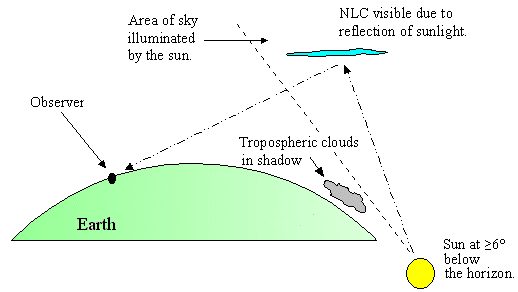
NLCs are Earth's highest clouds. Seeded by meteoroids, they float at the edge of space more than 80 km above the planet's surface. The clouds are very cold and filled with tiny ice crystals. When sunbeams hit those crystals, they glow electric-blue.
Noctilucent clouds are a summertime phenomenon. In the northern hemisphere, they usually appear in late May, then blossom in June and July as ice crystals multiply in the mesosphere high overhead. Here is an example of fully developed NLCs photographed last summer in Sweden:

Photo credit: Ruslan Merzlyakov of Umeå, Sweden. August 7, 2016
Interestingly, NLCs haven't always been here. They first appeared in the 19th century after the eruption of super-volcano Krakatoa. At the time, people thought the clouds were caused by the eruption, but long after Krakatoa's ash settled, the clouds remained. In those days, NLCs were a polar phenomenon confined mainly to the Arctic. In recent years they have intensified and spread with sightings as far south as Utah and Colorado. Some researchers believe the intensification is a sign of climate change.
Observing tips: Look west 30 to 60 minutes after sunset when the sun has dipped 6o to 16o below the horizon. If you see luminous blue-white tendrils spreading across the sky, you may have spotted a noctilucent cloud.
Realtime Noctilucent Cloud Photo Gallery